





Cannabis social club Mallorca: what is it?
A cannabis social club on Mallorca is a private, members-only, non-profit association where adults gather in a shared social setting rather than entering a conventional retail premises. In Spanish, the category is often described as a club social de cannabis, club cannábico or asociación cannábica. Those terms describe the association model, not a shop format. The distinction matters: a Mallorca cannabis social club is not a coffee shop and not a dispensary. It should not be understood as a high-street retail stop where anyone walks in to browse a menu, make a purchase and leave — the association format comes first, and the venue exists as a private social space with its own identity, expectations and way of operating, rather than as a conventional shop using cannabis as its main retail product.
A retail premises is generally a public-facing business: a person enters, browses what is available and completes a purchase. A social club is framed around membership and a private setting. Its identity comes from the association and the people registered with it, not from being an open shop on a commercial street. "Club" and "association" are not decorative labels — they signal a different kind of place and a different set of expectations, and that difference should be settled before anyone reads a listing, not after arriving.
What the word "social" means here
"Social" describes the character of the association as much as its physical layout. A club is built around a shared setting in which adults gather, not around the appearance of a standard commercial counter. That difference can affect the feel of the visit: some rooms may be informal, with sofas, low tables and conversation; others may feel more structured according to the association's own house rules and the character of its members and staff.
There is therefore no single Mallorca club style to expect. The island's scene is shaped less like a high-street retail category and more like a collection of independent social spaces. One association's atmosphere may be quiet and relaxed, while another's may feel more conversational or community-oriented. Those differences do not turn one venue into a coffee shop or another into a dispensary — they are variations within the private-association format. The common thread is an association structure, a private setting, registration and house rules, not the furniture. The social rhythm is shaped by members rather than by passing street trade, so the character of the space comes from the association's own community and operating style, not from a shop window.
Why the association format matters
"Association" is not decorative wording either. It signals that the club has its own identity and operates according to its own house rules. The setting, staff and members all contribute to how those rules are experienced in practice. A description of the venue can explain the general atmosphere, but it cannot replace the association's own standards or present every club as interchangeable — and this is also why a club should be approached as a private environment rather than as ordinary nightlife infrastructure. The relevant question is not simply whether a place looks welcoming from the street; it is whether the venue belongs to this association-based category and whether its own expectations fit the person considering it.
What a club is not
- Not a coffee shop — it is not presented as an ordinary café or casual walk-in hospitality venue.
- Not a dispensary — it is not a conventional retail outlet whose defining purpose is selling to the general public.
- Not one standardised chain — Mallorca's scene is a collection of independent associations, so identity and atmosphere vary from one to the next.
- Not a promise of identical house rules — each association sets its own, and a description of one club is not a description of every club.
Keeping these distinctions in view prevents the most common misunderstanding: treating the phrase "cannabis social club" as a softer name for a shop. In Mallorca, the useful starting point is the opposite: begin with private association, shared social space and independent house rules, then consider the character of the particular venue.
How to read a Mallorca club listing
Short labels can make different venues sound more alike than they really are. "CSC", "club cannábico" and "asociación cannábica" identify the general model, but they do not describe every detail of a room's atmosphere. A useful description separates the shared format from the individual club character: first, that the venue is a private, members-only, non-profit association; second, that its rooms, people and local setting give it a particular feel. A listing should be treated as an introduction to an association, not a promise that every detail will stay unchanged.
The directory currently records 26 active associations across Mallorca. That is a snapshot at a point in time, not a statement that every listing shares the same format, atmosphere or level of current information — counts and individual listing details change over time, so this page is an overview of the scene rather than a promise about any particular association.
Where are the clubs on Mallorca?
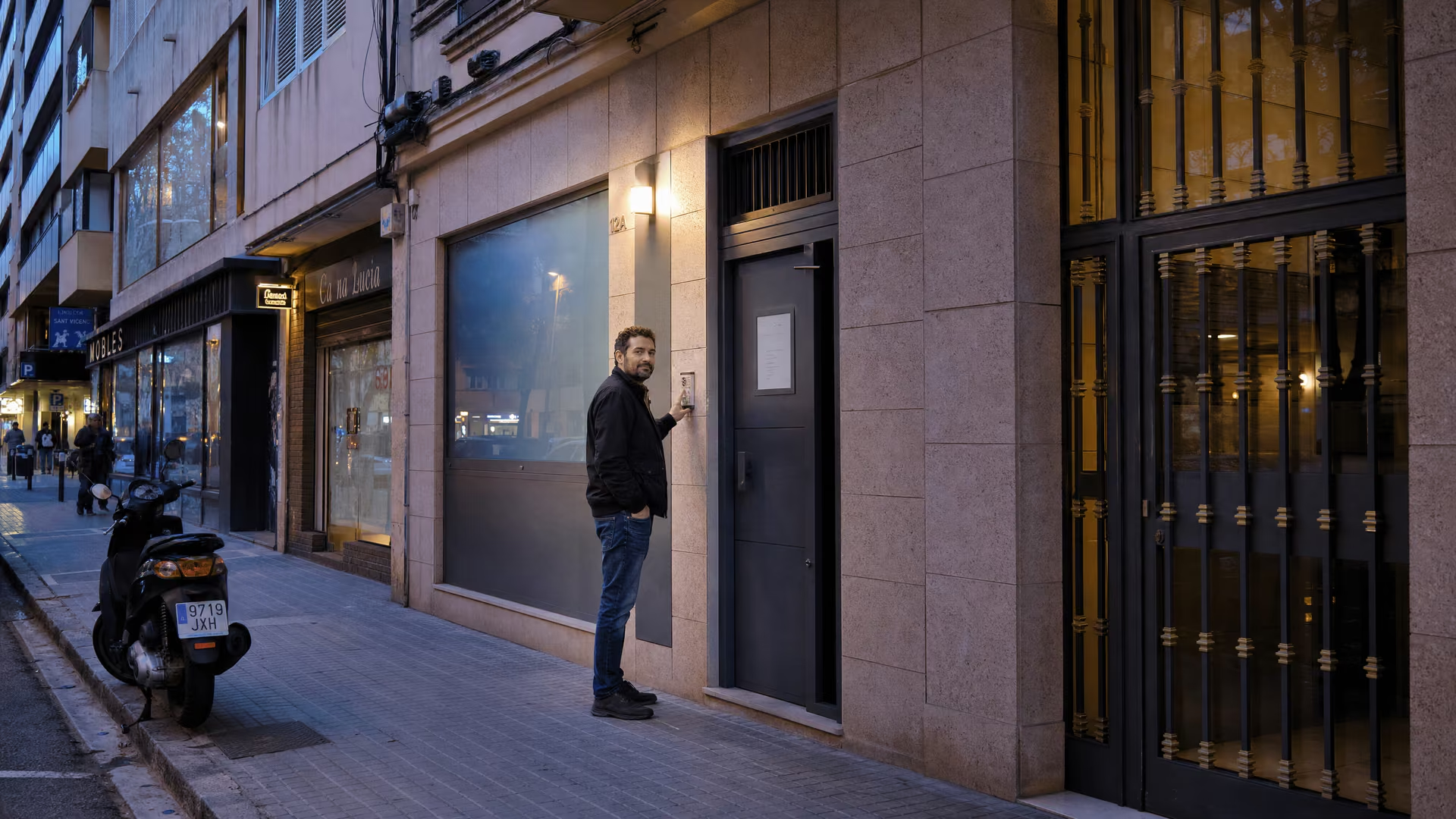
Palma is Mallorca's capital and principal urban visitor base, so it is often the first place people associate with the island's club scene. That shorthand is useful only up to a point. Palma is not one uniform district: its historic centre and La Seu area, Santa Catalina, the seafront and Portixol, El Terreno, Pere Garau, and the Playa de Palma and S'Arenal area are distinct urban contexts, not interchangeable labels — and "Palma" may identify the municipality or the broad urban area, but it does not tell you the character of the surrounding streets or how straightforward the journey will be from where you are staying.
A listing's location should be read alongside the municipality and the available transport options. The practical question is not simply whether a club is on Mallorca, or even whether it is in Palma, but which part of the island and which local setting the address actually belongs to. Someone based near the waterfront may be looking at the scene through a different set of streets and transport choices from someone staying around the historic centre; someone in Playa de Palma or S'Arenal should not treat a reference to central Palma as a precise indication of proximity.
The island is more than Palma
Mallorca is geographically dispersed. Magaluf, Santa Ponça, Alcúdia, Cala d'Or and Cala Millor are separate resort zones or municipalities rather than Palma neighbourhoods, and should be treated as their own destinations when comparing listings. A search that begins with the island as a whole can otherwise make locations appear closer or more interchangeable than they are. Someone searching "cannabis club near me" should check the actual area, not assume that a Palma listing is close to a resort elsewhere on the island — the useful sequence is to identify the area you are in, confirm the municipality shown by the listing, and then check the transport options for that specific journey.
Clubs by resort
Club data powered by cannabivo.com
The table above is most useful read comparatively: find the municipality closest to your base, then note whether a neighbouring one might also be practical. The largest count does not automatically make an area the right choice — a place with several associations may still be inconvenient if it is on the other side of the island, while an area with fewer may fit your accommodation and schedule far better. A rolled-up final row represents the remaining municipalities in the overview; use the directory's live listing rather than trying to infer a precise location from a summary row.
Palma is a set of different neighbourhoods, not one district
The neighbourhood around an association shapes the approach and the atmosphere outside, but it does not tell you everything about the private space itself. A first-time visitor may picture a lively public venue because a listing appears close to restaurants, bars or the waterfront; in practice, the association may operate as a quiet members' room with a reception process entirely separate from the surrounding street.
The historic centre is defined by limestone architecture, narrow streets and a concentration of civic and cultural landmarks — moving through it can feel very different from approaching a venue along a broader coastal or leisure corridor. Santa Catalina is known for its market, restaurants and leisure atmosphere, which makes it useful context for combining an appointment with other plans, but it is not a promise that a particular association is open for walk-ins or that reception operates late. El Terreno and Cala Major sit west of the centre, while Can Pastilla and Platja de Palma extend along the coastal corridor near the airport — these areas produce different expectations about distance and pace, and a result that looks close by district name may still need more deliberate planning once you consider the exact address and the route.
Use the neighbourhood name as an orientation aid, not as evidence of access. It can help you understand which part of Palma you would be visiting and whether the setting fits your wider plans; it cannot confirm that an association is active, that it is accepting applications, or that you can enter without completing the required contact or appointment steps. A busy street outside does not make the room inside public, and a quieter location does not mean the association will be flexible about arrival time or documentation — the location answers "where is this?"; the association's current instructions answer "can I attend, and how?"
Before setting out to any neighbourhood, four practical questions matter more than the district's reputation:
- Is the listing current? Check whether the information appears maintained rather than assuming a search result reflects the present situation.
- Is the association accepting applications? A location may remain visible online even when the association is not taking new requests.
- What identification is accepted? Confirm this before travelling, since arriving without the required document can make the journey unnecessary.
- Is reception open when the appointment is scheduled? A neighbourhood may be lively at the time you visit, while the association's own reception follows a different schedule.
A place name gives a useful starting point, but it does not answer every question about an association on its own — it can help you compare an urban setting around Palma with a resort or town context, yet it cannot by itself confirm how a particular association handles membership. Look at which location is described, whether the contact information appears current, and whether the association explains its membership process in clear terms; if an important point is missing, treat that as a reason to ask rather than filling the gap with an assumption based on another listing.
Club locations
Open the interactive map to see where every club is, zoom into any town and tap a marker for its details.
What does the directory show?
This Mallorca directory presents independent associations as listings rather than ranked venues, and individual status, membership criteria, opening arrangements and municipal activity can change over time. It provides neutral background and points readers towards independently maintained association listings — the page is a starting point for checking what may be available, not a substitute for confirming arrangements with an association. It does not rank clubs or present one association as better than another, and it does not publish product information or fill gaps by inventing details the source data does not support; where information is unavailable, the responsible approach is to leave that gap visible rather than make a guess sound like a fact.
What the directory is showing
The directory shows the association as a practical entry in a broader Mallorca overview. Its purpose is to help you identify which listings are currently represented, understand the type of organisation being described, and place that information in the context of the island's geography. The useful information is structural: what a cannabis social club is, how membership generally works, why a private association differs from a coffee shop, and how Palma and the island's resort geography affect searches. This structure helps separate general explanations from association-specific information — general guidance can describe the model shared by private associations, while the individual listing supplies the details that belong to one association.
A listing gives a practical reference point: an association has been included in the directory, and the available source information can be reviewed before deciding whether to make contact. That helps separate a named organisation from an unverified rumour, an old recommendation or a search result whose current status is unclear. The listing is an information layer, not an appointment. The association remains the appropriate source for its own current arrangements.
A current snapshot, not a permanent register
Listings are updated over time, but readers should still verify current details with the association before making plans. The directory should be treated as a current snapshot, not a permanent register whose every detail remains unchanged — an association may alter its arrangements, update its information, or no longer have the same status when you are ready to visit. A directory entry is not a promise that an association will accept an application, answer immediately or offer the same process throughout the year. Seeing an association in the directory does not, by itself, confirm that an application will be accepted, that a response will arrive on a particular schedule, or that the process described at one point will remain identical later.
Verification is a directory status, not an endorsement — it indicates how a listing is treated within this page's information, not that the page recommends it or takes responsibility for the association's decisions. Direct confirmation is not an optional extra added after the directory has done its job; it is the step that deals with the time gap between a listing being reviewed and a reader making plans.
How to read a listing before relying on it
Start with the listing as an orientation tool. It can help you decide which association entries deserve closer attention and which part of Mallorca is relevant to your plans. Then separate the information into two questions: what does the directory explain generally? and what must be confirmed with this association?
- Use the general information on this page to understand the private-association model and the difference between a social club and a coffee shop.
- Use the resort-by-resort overview above to see how listings relate to Palma and the island's resort geography.
- Use the individual entry below for the association's name, address and other association-specific details.
- Verify current status, membership criteria and opening arrangements directly before making plans.
This approach also avoids reading absence or presence too strongly. A directory listing provides the entries currently represented; it does not turn every entry into a recommendation, and it does not make a changing municipal scene permanently settled. The island's geography can affect how people search, but the directory's role remains descriptive: it organises available information so that a reader can investigate the relevant association rather than assume that all areas or organisations work in exactly the same way.
This is an informational directory of independent associations: it offers introductions only, and membership is always at each association's discretion and never guaranteed.
Featured clubs
Premium clubs


Top-rated clubs


Small Club
Open now

Crazy Spot CSC
Open now

Social Temple Club 420
Open now

Medusa 23
Open now

Sensitive Alcudia Weed Club
Open now

Relax Life
Open now
Private Social Club 420
Open now

Happy Terp Club
Opens at 16:00

Cloud 420
Open now

Highribot Cali Club
Open now

The Green Door
Open now

Jungle Boys 420
Open nowClub data powered by cannabivo.com
The Fast-Track pass — how we can help
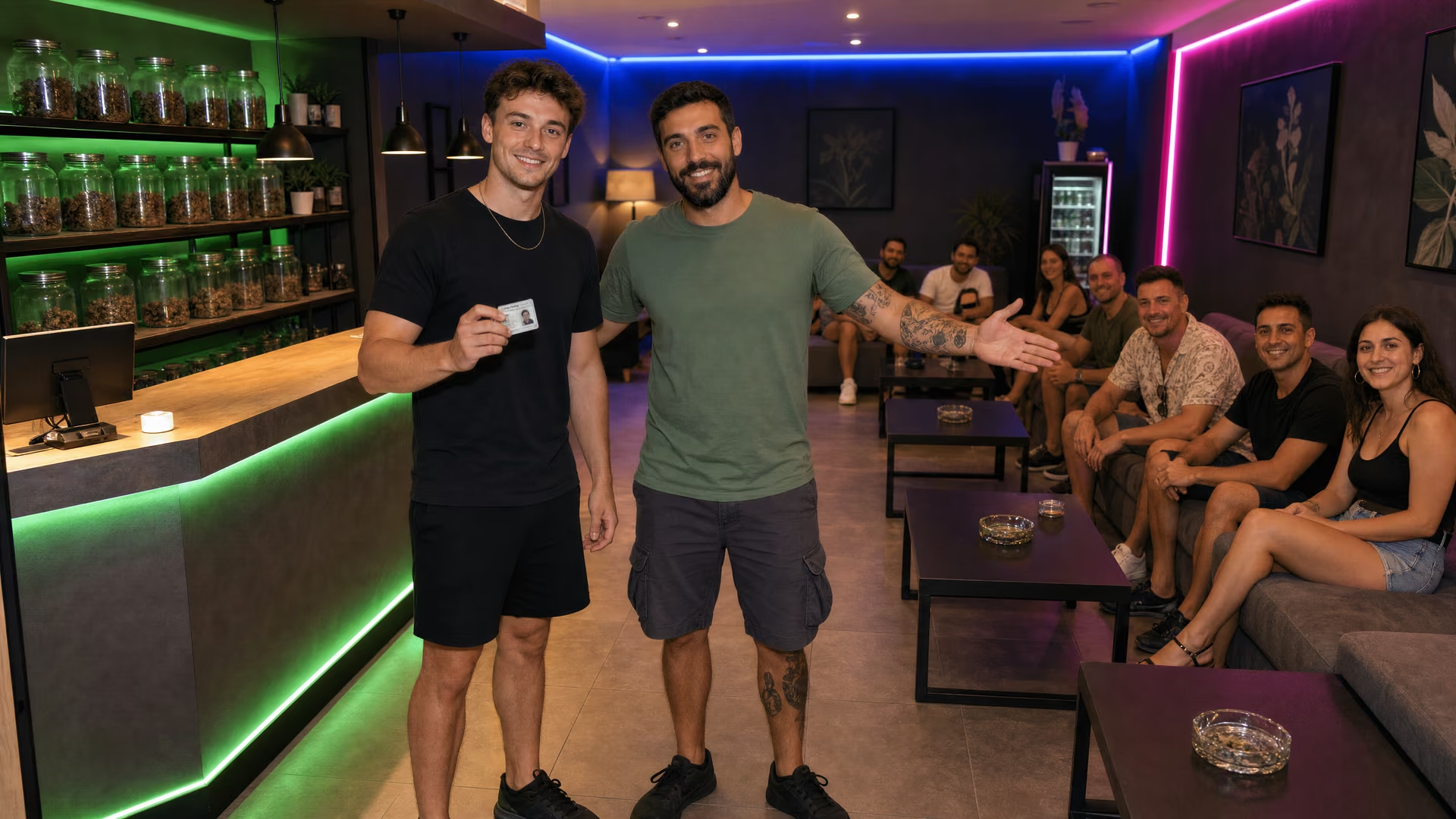
Getting into one of those associations is a private process, run by each of them on its own terms — and for a visitor navigating it for the first time, from a different country, in a language that is not the association's own, that process can be slower than a short holiday allows. This is the gap a Fast-Track pass exists to close.
A Fast-Track pass is an introduction service, not a membership and not a purchase of cannabis itself. It connects a verified adult visitor with an association willing to receive Fast-Track members, handles the identification and registration steps in advance, and removes the guesswork of contacting an association directly, waiting for a reply, and hoping the documents you brought are the ones actually accepted. It exists specifically because the sequence described throughout this page — contact, wait, register, confirm — assumes time and local familiarity that a short trip does not always allow.
In practical terms, that means the age and identification check, the introduction to a receiving association, and the registration paperwork are arranged before you arrive rather than negotiated at the door. It does not change what the association itself requires, and it does not replace the association's own house rules once you are inside — it shortens the distance between deciding you want to visit and actually being able to.
It is genuinely useful for someone arriving with limited time, no existing contact at an association, or no confidence navigating the process in Spanish — and it is worth being honest about how much that limited time actually costs you going it alone. Every step covered earlier in this guide — finding a receiving association, sending the right enquiry, waiting for a reply that may take days or never come, confirming an appointment, gathering the right identification — is real friction for someone with a week on the island, not a formality. Entry is always at the association's discretion regardless of which route you take; what Fast-Track changes is how much of that friction happens before you land rather than during your trip. The single-club Fast-Track pass covers one association of your choice.
It is not necessary for everyone — a longer-staying visitor who is comfortable making direct contact with an association, following its own registration steps and can absorb a slow or uncertain reply does not need it, and should feel free to use the guidance above instead. Read it as one route among several, honestly described, not as the only way in.
What the words mean
Search language can make Mallorca's scene seem more familiar than it is, because the words people type come from several different cannabis cultures, countries and business models, so the first result may not describe the same kind of place a visitor has in mind. Words are useful for finding information, but they are not a promise about the venue behind them.
"Cannabis social club" and "association"
"Cannabis social club" describes the association setting used throughout this guide. The important part of the phrase is not simply "cannabis"; it is "social club" — that wording points towards a private association context rather than a public shopfront or a general tourist attraction. You may also see "cannabis association" used in its place; in ordinary search language the two expressions point towards the same broad type of place, though neither identifies one particular association or tells you what a specific venue currently allows, discusses or has available — those details belong to the individual association and may need to be confirmed directly.
"Social club Mallorca" is wider still. It is a broad search phrase that may refer to cannabis associations, ordinary leisure clubs or unrelated nightlife venues. Someone searching those words could be looking for a cannabis-related association, a social space with no cannabis connection, or a venue described using "club" in the nightlife sense. Do not treat every result for "social club Mallorca" as a cannabis association. Read the result carefully and check what kind of organisation it actually describes.
"Weed", "marijuana", "cannabis" — and why "coffeeshop" misleads
"Weed" and "marijuana" are informal words for cannabis. They are common in conversational searches, travel posts and user-written descriptions because they are familiar and quick to type. "Cannabis" is the broader, more neutral term used in the phrase "cannabis social club", as well as in many association descriptions. These words can lead to overlapping results without carrying exactly the same tone — a page using "weed" may be written in casual language, a page using "cannabis" may use association or organisational language, a page using "marijuana" may simply reflect the wording chosen by the searcher. The vocabulary does not by itself establish what kind of venue you have found. It is a starting point for identifying the subject, not a substitute for reading the venue's own description.
A coffeeshop is associated internationally with the Amsterdam model. That association is strong enough that a visitor may use "coffeeshop" as a convenient label for any place connected with cannabis. In Mallorca, however, a cannabis social club is not an Amsterdam coffeeshop. Using "coffeeshop" in a search may bring up international guides, travel comparisons or pages written for a different model, and it can cause a reader to interpret a Mallorca association through the habits of Amsterdam tourism — a visitor who arrives expecting the Amsterdam model may misunderstand the setting before the conversation has even started. When a page or message says "cannabis social club", keep that phrase rather than silently translating it into "coffeeshop".
"Dispensary" usually suggests a public retail or clinical setting. It is a useful word in contexts where products are dispensed through one of those models, but it is not what the private association description means here. Calling an association a dispensary can make the place sound more like a public shop or a clinical service than the description supports. A searcher using "dispensary" may expect a simple retail-style visit, while a searcher using "association" is at least looking for the private club setting described by the venue — neither label tells you the current policies of a particular association, but the labels shape the question you think you are asking. Choose the term that matches the setting you are actually trying to find, and do not use "coffeeshop", "dispensary" and "cannabis social club" interchangeably in a message: each carries a different international association, and the wrong one can create inaccurate expectations at reception.
No — a cannabis social club on Mallorca is not a coffeeshop, and it is not a dispensary either. It is a private members' association: there is no public counter, no visible menu and nothing sold to a walk-in customer, so the Amsterdam comparison and the American-style dispensary comparison both import the wrong model. Search phrases like cannabis club Mallorca, weed Mallorca or coffeeshop Mallorca are useful for finding this page, but the search wording does not redefine what the venue is — it describes what the person wants to find, not what the destination actually is. Listings avoid product menus, sales language and promises about availability for the same reason: a product menu would encourage the reader to interpret the association as a conventional outlet, and that is not what it is. If you want the full point-by-point comparison — legal status, access, atmosphere, what each model actually offers — we cover coffeeshops on Mallorca separately, in detail.
"Mallorca" and "Majorca"
"Cannabis Majorca" and "cannabis club Majorca" are alternative spellings used by searchers who write Majorca rather than Mallorca. They describe the same island in ordinary travel language, so trying both forms when searching can surface pages, directories or conversations that use one spelling consistently. Neither phrase identifies a specific association or its current policies — treat "Majorca" as a search variant, not as a separate scene. The spelling changes; the island being referenced does not. Once you reach a particular listing or association page, use that page's own wording to understand what it claims to describe.
Words used inside cannabis conversations
Members may use everyday vocabulary such as "strains", "flower", "hash", "concentrates" and "edibles" when discussing cannabis culture. "Strains" is commonly used when people talk about different varieties or types; "flower" refers to the plant material people may discuss; "hash", "concentrates" and "edibles" are other familiar terms in cannabis vocabulary. Their appearance on a page, in a conversation or in a search result tells you that the writer is using cannabis-culture language — it does not, on its own, describe a public menu, a retail offer or a guarantee of availability. Vocabulary is not availability. A mention of a category does not confirm that a particular association currently has it, offers it, or discusses it under the same terms. None of these search terms replaces the specific association's own information; they help interpret what a page may be talking about, but they do not identify a venue, establish its current policies, or guarantee what you will encounter when you make contact.
How do cannabis clubs work on Mallorca?
The private association model places membership before entry. In practical terms, a person does not usually begin by walking into an open retail counter and browsing as a member of the public. The first step is normally to contact an association and find out how that particular association handles prospective members. That initial contact may be used to explain the association's information, its house rules and the steps required before anyone arrives.
The process starts before the visit
After making contact, a prospective member reviews the information supplied by the association. This matters because there is no single Mallorca-wide procedure that every association follows. One association may explain its arrangements directly; another may ask for an invitation, a referral, a sponsoring member, a QR code or a written introduction. These are different ways of beginning the conversation, not interchangeable guarantees of entry. The next stage is normally registration: the person completes the association's registration form and presents identification at reception. That establishes the practical sequence — contact, review the information, complete registration and show identification — though the exact order, the documents requested and the way the association communicates remain matters for that association to explain.
An invitation, referral or introduction should not be treated as automatic acceptance. It may provide the route by which a person makes contact, while the association still applies its own process. These customs vary and do not guarantee acceptance. Someone planning a visit should avoid assuming that a code, recommendation or sponsoring member settles the matter in advance — the association's current instructions are the useful reference.
What happens once the association's process is followed?
Once the relevant registration steps have been dealt with, the setting is organised around membership rather than passing trade. The association's own policies determine how people check in, where they may spend time and how they are expected to use shared spaces — the result is usually less like a quick transaction and more like entering a private, member-oriented environment with rules that apply to everyone present. House rules commonly shape check-in, privacy, conduct, photography, shared spaces and responsible consumption. A rule about photography, for example, concerns privacy and the shared environment; a rule about conduct sets expectations for how people interact; rules for shared spaces help prevent one person's visit from disturbing everyone else.
A visitor should not assume that ordinary public-venue habits automatically apply. Before taking photographs, using a shared area or treating the space as somewhere to linger, it is sensible to follow the association's stated instructions. The same applies to consumption: responsible consumption is part of the house-rule framework, rather than an invitation to ignore the setting or the people around it.
The atmosphere is usually lounge-like
The atmosphere can resemble a quiet members' lounge rather than a shop. People may talk, read, listen to music or sit together — the room may be a place to spend time within a member setting, not simply a counter where someone arrives, makes a purchase and leaves. Conversation may touch on strains, flower, hash, concentrates and edibles as part of the wider cannabis culture; such subjects can form part of the social atmosphere without turning the room into a public marketplace. The distinction is between a private association environment in which cannabis-related conversation may occur and the assumption that the venue operates as an open shop.
That lounge-like atmosphere can vary considerably from one association to another. One may feel more conversational, while another may be quieter; one may place more emphasis on sitting together, while another may have a different arrangement for its shared spaces. The approved description is a useful expectation, not a promise about every room — each association sets its own policies and membership process, so the individual association remains the authority on how its space works.
Why current information matters
Information found in a directory or in an earlier message can help a person identify an association and understand the general model, but it should not replace direct confirmation. Opening arrangements, registration requirements and house policies belong to the association itself and may not be identical across the island. A listing can point someone in the right direction; it cannot make an association's decision on its behalf.
For that reason, current information should be checked with the individual association before relying on a listing. Confirm the association's own process, whether it requires an invitation or introduction, what registration involves and which identification must be presented at reception. It is equally important to check the current opening arrangements and the rules covering privacy, photography, conduct, shared spaces and responsible consumption. In short, Mallorca's club experience is structured around a private association sequence: make contact, read the association's information, follow its registration process, present identification and then observe the house rules in a member-oriented space. The social atmosphere may be relaxed, but the process is not interchangeable from one association to the next.
Questions to ask before contacting an association
Before contacting an association, prepare a short list of practical questions rather than sending a long personal introduction. The aim is to find out whether your visit can be handled, what information you need to provide and what you should expect at the door. Keep the tone neutral and respectful: you are asking about the association's process, not demanding access.
Start with the questions that determine whether contact is worthwhile
The first message should establish whether the association is currently accepting applications. A listing, social-media profile or older recommendation does not by itself confirm that applications are open now — ask directly whether they are accepting new members, whether applications are being reviewed at present, and whether there are any current limits on visits or registrations.
Ask which identification the association accepts. Do not assume that the document you normally carry will be sufficient; a useful question is "Which form of identification should I bring for registration?" If the association requires a particular document or wants information checked in advance, discover that before making the journey rather than after arriving. Then clarify whether an appointment is needed — ask whether you may attend during reception times or whether the association only receives prospective members at a pre-arranged time, and how an appointment is requested. An appointment question can prevent an unnecessary journey, especially if you are unfamiliar with the area or arranging transport around a specific time.
Ask how registration actually works
"How do I join?" can produce a vague answer, so break the process into smaller questions. Ask whether the initial contact is followed by an appointment, whether registration takes place in person and what information is needed at that stage. You can also ask how long the registration process usually takes without assuming that approval is automatic. It is useful to ask whether a membership card is issued — if one is provided, ask when it is issued and whether it is needed for later visits; if no card is issued, ask how membership is recorded and what you should do when you return.
Keep the wording open rather than presenting a list of demands. A practical structure for one complete, easy-to-answer message:
- "Are you currently accepting applications?"
- "Which identification do you accept?"
- "Do I need an appointment, and how do I request one?"
- "Could you explain how registration works?"
- "Is a membership card issued, and if so, when?"
- "What does the membership fee cover, and is payment cash only?"
Add a question about photography, guests or privacy only where it affects your visit — for example, "May I bring a guest, or must each visitor contact you separately?" if you are travelling with someone, or a direct question about whether photography is permitted if that matters to you. A simple structure works well: greet the association and say you are enquiring about applying for membership, ask whether it is currently accepting applications, ask about identification, appointments, registration and membership cards, ask what the fee covers and whether payment is cash only, add any relevant follow-up, then thank the association and wait for its response. You do not need to explain your entire background or negotiate an exception in the first message.
Read the reply without filling in the gaps yourself
When a response arrives, separate what it clearly confirms from what it leaves unanswered. A greeting, an address or a general invitation may not answer whether applications are currently open, what identification is accepted or whether an appointment is needed. If a necessary detail is missing, send one polite, focused follow-up rather than several messages sent over a short period.
No response is also information — it means you do not currently have the confirmation needed to rely on that contact, not permission to arrive unannounced. Do not turn silence into permission, and do not make repeated enquiries, change channels repeatedly, or ask several unofficial intermediaries to obtain an answer. A directory can help you locate information, but it cannot decide whether an application is accepted or replace the association's own instructions; the same applies to unofficial intermediaries who claim they can arrange access on your behalf.
If the association declines an application, says it is not accepting applications, or does not provide the arrangement you need, accept the answer without pressure. Do not argue that you have travelled a long way, that someone else recommended you, or that another association has different rules. The association decides whether an application is accepted, and a respectful enquiry has to allow for a refusal or a lack of availability. After a reasonable follow-up, give the association space to respond; if there is still no reply, treat the visit as unconfirmed and do not plan around entry.
How to join a cannabis social club on Mallorca
How to join depends entirely on the association — there is no single island-wide membership procedure that every private cannabis social club follows. The useful starting point is not assuming that one club's instructions apply elsewhere, but checking whether the particular association is accepting applications and what it currently asks prospective members to do. Before making a journey, check the association's current instructions rather than assuming that every club uses the same system.
A typical sequence
The general process begins with checking availability, contacting the association through its current channel, completing a registration or membership form and presenting identification at reception. The order can vary, so treat this as a practical sequence rather than a guaranteed script.
- Check that applications are currently being accepted. An online profile or previous recommendation is not enough to establish that reception is open to new applications now.
- Send a current enquiry through the channel the association identifies for membership questions and ask for its present procedure.
- Clarify any introduction requirement. Some associations use an invitation, referral, sponsoring member, QR code or written introduction; others explain their own process directly.
- Complete the requested registration or membership form. Read the information being provided and make sure the details you give match your identification.
- Bring the identification requested — typically a passport, DNI or other accepted photo ID — and present it at reception when asked, rather than assuming a photograph, photocopy or different document will be accepted.
- Wait for the association's decision. Completing a form does not remove the association's discretion over whether the application is accepted.
Some prospective members may be told to arrive with a named member's introduction, a referral or a written message; others may receive a QR code or direct instructions from the association itself. Do not substitute an invented workaround for a requirement you have been given. If you do not have the requested introduction or cannot complete the stated step, ask the association what it wants you to do instead. A membership card may be issued after registration, although its format and use vary — its timing and format are set by the association. Some applicants receive confirmation before visiting, while others complete the relevant steps in person; do not assume that arriving at the address automatically completes the process, or that being referred by a member guarantees entry.
Confirm the details before crossing Mallorca
Mallorca is an island, and a journey to an appointment can require more planning than a short walk to a nearby venue. It is sensible to confirm the appointment process, identity documents, payment method, opening arrangements and house rules before travelling across the island — the aim is not to extract a guarantee from the association, but to make sure you understand the conditions it has communicated.
- Appointment process: ask whether you should arrange a time, wait for confirmation or follow another stated procedure.
- Identity documents: ask what the association accepts and whether the document must be presented in person at reception.
- Payment method: confirm which method is available for the membership or registration step, rather than assuming your preferred method will be accepted.
- Opening arrangements: check the current reception arrangement for the time you intend to arrive.
- House rules: request the rules that apply to members and make sure you are willing to follow them before completing the journey.
Keep the exchange clear and retain the practical information you were given. If the association tells you to bring a particular document, follow that instruction. If the message leaves an important point unresolved, ask one focused follow-up question rather than arriving and hoping reception can sort it out. A message that is unanswered, an outdated social profile or a closed reception does not establish current availability — online information can remain visible after circumstances have changed, so the safest conclusion from silence is simply that you have not confirmed the process. A location appearing on a map does not by itself confirm that reception is operating or that applications are being accepted.
There is no single checklist that guarantees entry to every Mallorca association. One club may be appointment-led and document-focused; another may explain its process more informally. An invitation may be relevant in one case and not in another, and payment arrangements can differ as well. The reliable approach is to treat the published or directly supplied instructions as the starting point, prepare the requested identification, and wait for confirmation where the association requires it — approaching the process in that order makes the visit more predictable: confirm the association's current status, ask for its requirements, prepare the requested documents, attend under the stated arrangement and follow the house rules. If any of those points cannot be confirmed, postpone the journey rather than treating uncertainty as permission to arrive without notice.
Who is membership for?
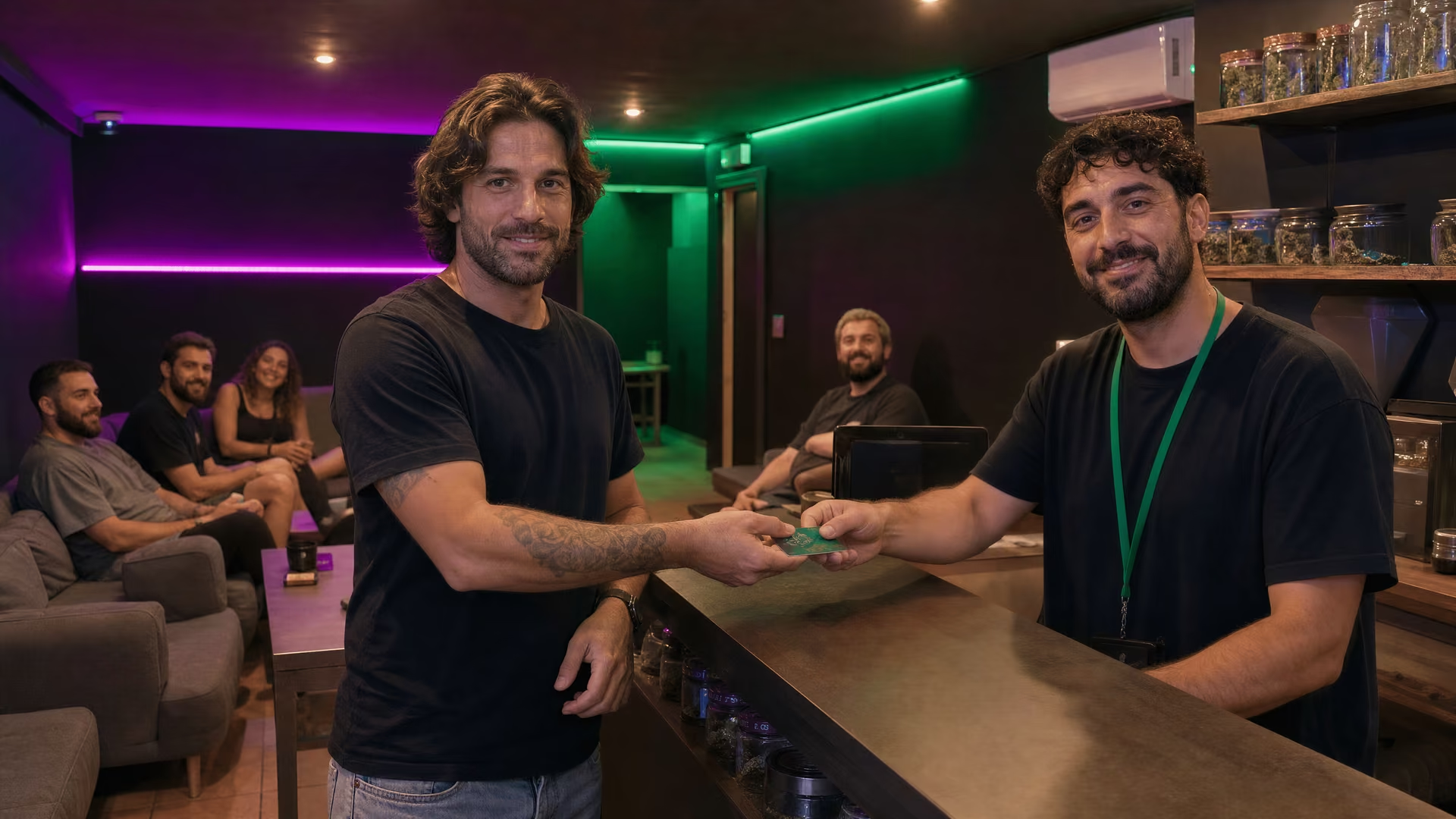
Membership is for adults who are prepared to join a private association on that association's terms, not for anyone looking for an ordinary walk-in public venue. In practice, the first threshold is age: membership spaces are adults-only, for people aged 18 or over. An association may ask to see identification during sign-up so it can confirm the applicant's identity and age. That identity check is not just a formality — it gives the association a way to match the person applying with the person who will hold the membership. The association is responsible for explaining its own membership criteria, so the details of the sign-up conversation can differ from one place to another.
Residents, workers and visitors may all ask about joining
Membership is not limited to one single type of person. Applicants may be residents, workers or people spending time on the island. Someone living locally may want to understand how the association fits into their routine; a worker may be on Mallorca for part of the year; and a visitor may be considering membership while spending time there. Those situations are not automatically equivalent, however — being on Mallorca does not guarantee that every association will offer the same route to membership.
The useful question is not simply "Can a visitor join?" It is "What does this particular association require from this applicant?" There is no universal membership route for every association — one may ask for a prior introduction, another may require a scheduled appointment, and another may assess an application in its own way. An applicant should check the association's current instructions before travelling to reception, especially if the visit is being fitted around work, accommodation or a short stay.
Expect the process to vary between associations
A first enquiry may be a request for information rather than an immediate membership approval. The association may explain its criteria, ask the applicant to arrange a time to attend, or require a prior introduction. If an appointment is needed, turning up without one may not produce the result the applicant expected. If an introduction is requested, clarify what the association means by that requirement instead of treating an informal recommendation elsewhere as automatically sufficient.
There is also no promise that an application will be accepted. An association may decline an application without giving the same explanation another association would give. That possibility is part of the distinction between applying for membership and buying access to a public-facing business. A refusal at one association does not establish a general rule for the island, just as acceptance by one association does not create an entitlement to join another. For that reason, an applicant should keep expectations practical: read the association's own information, follow the requested sequence, bring the identification needed for the identity-and-age check, and allow time for the association to explain its criteria. If the instructions are unclear, asking before attending is more useful than assuming a process used elsewhere will be accepted here.
Membership belongs to the individual
Once a person is accepted, membership is personal rather than transferable — it belongs to the member who applied and was admitted, not something to lend to a friend who has not completed that association's process. A membership card should never be treated as a spare pass for another person. A member should not assume that bringing an unregistered guest into a private room is acceptable simply because the guest is known to them or is also an adult — if another person wants access, that person should ask the association what its own membership procedure requires.
The same principle applies to images and personal information. Members should not photograph other members without consent — people may be present precisely because they expect a degree of privacy, and capturing or sharing an image can affect someone who has not agreed to be included. Asking before taking a photograph respects the conditions under which people participate.
Who is likely to fit the setting?
The setting is most suitable for an adult who is willing to identify themselves, follow the association's stated criteria and accept that the process may not be identical to a previous experience — that can include a local resident, a worker or someone spending time on Mallorca, provided the person approaches the individual association rather than relying on assumptions about the whole island. It is less suitable for someone expecting anonymous, instant or transferable access, or a person who wants to bring unregistered guests into a private room, treat another member's card as public property, or photograph people without asking. The practical test is respect for the association's boundaries: personal membership, adult-only access, the association's own application route and the privacy of other members.
Membership and association culture
Membership is the centre of the club model. The association is not simply a place where a visitor completes a transaction and leaves — it is a private communal setting organised around people who have chosen to become members, accept the association's way of operating and contribute to its ongoing life. That difference affects the tone of an interaction from the first message or visit: the person making contact is asking to participate in an association, not merely looking for an anonymous service counter.
A non-profit association may describe contributions as a membership fee, annual fee, donation or shared-cost contribution, depending on its own language and accounting practice. Those labels should not be treated as interchangeable without asking the association what they mean. A phrase that sounds familiar may refer to a recurring payment, a contribution connected with registration, or a different part of the association's internal arrangement. The useful question is not which label sounds most convenient, but what the contribution covers, when it is due and whether the association explains it clearly.
Membership is a relationship with an association
The word "member" carries more weight here than "customer". A customer usually expects a standard service, a posted price and a quick exchange. An association member may instead be entering a shared structure with its own statutes, registration procedures, meeting arrangements and expectations of conduct. The precise balance varies between associations, but the underlying idea is that the member is connected to the organisation rather than passing through it anonymously.
This can make the first contact feel more conversational than commercial — an association may need to explain its own approach, ask for information relevant to registration, or direct a prospective member to a particular procedure. That is not necessarily a sign that the process is difficult; it may simply reflect the fact that each association manages membership in its own way. Equally, a prospective member is entitled to seek a clear explanation before agreeing to anything. Clarity about the relationship matters more than adopting the association's terminology without question. The same principle applies after registration: a member may be expected to understand the association's house rules, respect the shared space and communicate directly when something is unclear.
Different associations can emphasise different things
Some associations describe collective cultivation shared among members as part of their philosophy; others focus more visibly on social space, conversation and private communal life. Neither description should be assumed to represent every association on the island — the practical experience can be shaped by statutes, registration procedures, meeting arrangements and the character of the member community. In one setting, conversation about cultivation, varieties or shared practices may be an important part of how members understand the association; in another, the social room may be the more noticeable feature, with people using the space to talk, listen to music or spend time with others. Asking how the organisation describes its own purpose is more reliable than relying on a general image of what a cannabis social club "should" be.
There is no single membership culture to perform. A person does not need to arrive pretending to have specialist knowledge, and an experienced member should not assume that everyone shares the same interests. A respectful association can accommodate different levels of familiarity, provided people allow others to participate at their own pace and follow the rules of the shared setting.
Shared space means shared responsibility
Members often arrive with different expectations. One person may value a calm room for conversation; another may be interested in local cannabis culture, music or informal knowledge exchange; another may simply want to spend a little time in a private communal environment. Courtesy begins with recognising that the association is a shared environment, not an anonymous service counter. A member can pay attention to the tone of the room before taking over a conversation, avoid assuming that everyone wants to discuss the same subject, and treat staff or volunteers as people managing a community rather than as anonymous intermediaries.
Shared space also requires respect for personal boundaries. Not every member will want to explain their reasons for joining, discuss personal circumstances or answer questions about what they use. Membership does not remove the need for consent, privacy or discretion. The same applies to photographs, recordings and sharing details about other people outside the association: when in doubt, ask rather than assume. Small behaviours are easy to overlook but matter — leaving communal areas as they were found, following any instructions about where to sit or store belongings, and raising problems directly with the association all support a more workable atmosphere.
Learning the association's own language
Because associations may use different terms for contributions and membership, a short exchange can prevent considerable confusion. Ask what a stated contribution represents, whether it is connected with annual membership, how registration is recorded, and whether a membership card is issued. The purpose is not to challenge the association's identity, but to understand the arrangement before relying on it. Ask for meanings, not just labels. "Donation", "fee" and "shared-cost contribution" may carry different meanings within different organisations, and the association itself is the appropriate source for explaining its accounting practice and membership procedure. A directory description can help identify an association and decide whether to make contact, but it cannot interpret a particular organisation's current terms on its behalf. Questions about annual contributions, cash-only arrangements, membership cards and registration should always be directed to the association itself.
What membership may require
Membership is often less about a single "sign-up" moment than about completing a short sequence of administrative checks. A person may first contact an association, explain that they would like to enquire about membership, and ask what the association currently requires. The response may set out whether an introduction is needed, which identification is accepted, whether a form is sent in advance and whether an appointment is necessary. The first useful step is to confirm the current process before travelling to reception.
Start with the association's current instructions
There is no single checklist that applies to every association. One may ask a prospective member to arrive with personal details and photo identification; another may want a prior introduction or referral; another may ask the person to arrange an appointment before coming in. These differences are administrative rather than something a visitor should try to resolve by guessing.
A clear enquiry can be simple: ask whether the association is accepting membership enquiries, what documents it accepts, whether a form must be completed, whether an introduction is required and whether a visit needs to be booked. It is also sensible to ask whether the association has any particular house rules or membership information that should be read before attending. Do not treat a general description of club culture as a substitute for the association's own instructions. Current instructions matter because procedures can change — a message that was accurate at one point may no longer describe the process when a person is ready to visit, which is why a direct, current response is more useful than relying on an old post, an outdated screenshot or a forwarded message.
Identification and personal details
Common administrative steps include submitting personal details, showing a passport, DNI or other accepted photo identification, completing a form and acknowledging the house rules. The important word is accepted: having a document that proves identity in another context does not automatically mean an association will accept it for membership. The association may specify a passport, DNI or another form of photo identification, and a visitor should follow that specification rather than assume every document is interchangeable.
If the requested document is not available, ask before making the journey — do not wait until reception and hope that an alternative will be accepted. A polite message explaining what document is available allows the association to give a clear answer, while an assumption can lead to an avoidable refusal or an unfinished application. Forms also deserve attention rather than being treated as a formality: read each question carefully, provide the personal details requested, and ask for clarification if an instruction is unclear. Membership should not be approached as a way to bypass the association's procedures — it depends on completing the steps the association actually sets.
Introductions, referrals and appointments
Some associations ask for a prior introduction or referral. That does not mean a visitor should arrange one through a random third party or assume that any message mentioning the association is sufficient. If an introduction is required, ask the association how it should be made and whether the person introducing the prospective member needs to follow a particular process. A referral is not proof of membership, and a contact is not an approval. The same caution applies to appointments — if the association says one is needed, treat that as part of the membership process rather than an optional convenience, confirm the agreed time and any documents to bring, and if no appointment is needed, follow the instructions actually given instead of relying on a pattern from another association.
Keeping the sequence clear helps avoid confusion:
- Ask the association what the current membership requirements are.
- Confirm whether a prior introduction or referral is required.
- Check which passport, DNI or other accepted photo identification should be shown.
- Ask whether personal details must be submitted before the visit or at reception.
- Find out whether a form must be completed and whether the house rules must be acknowledged.
- Confirm whether an appointment is required.
- Wait for a clear response before treating the visit as arranged.
What online information can and cannot establish
A directory entry, map pin or social account can help a person locate an association or identify a way to make contact, but it cannot by itself establish that membership is available on particular terms. Online information may be incomplete, may refer to an earlier procedure, or may not explain which documents are currently accepted — a screenshot from an old social account can be less useful than a current direct response. Use public information to form an enquiry, not to fill in missing requirements by assumption. A directory entry does not turn a person into a member; nor does a map pin, an enquiry sent to someone else, or an unanswered message. If no clear response has arrived, the sensible position is that the process remains unresolved.
House rules are part of the requirement
Acknowledging the house rules is not merely an administrative signature at the edge of the process — it signals that the prospective member has been given the association's expectations and is prepared to follow them. Read those rules before agreeing to them, and ask about any point that is not understood. Responsible consumption forms part of that respectful club culture: a member should understand their own limits, follow staff guidance, avoid putting pressure on other members and help keep private association spaces calm and considerate. That means not treating another member's choices as an invitation to participate, not encouraging someone to exceed their comfort level, and not turning staff guidance into a debate. Membership carries an obligation to respect both the association's rules and the boundaries of other members.
If the requirements are still unclear, ask one focused follow-up rather than arriving with several assumptions — state which document is available, explain which part of the procedure is unclear, and ask whether an appointment or introduction is needed. In practical terms, the requirement is straightforward even when the details vary: confirm the process, bring what has been accepted, complete the requested steps and follow the house rules. Everything else should be checked with the individual association rather than borrowed from an old post, another venue or a third party's experience.
Costs and contributions, honestly

There is no reliable island-wide price range that can be stated without inventing figures. Associations set their own membership fee, annual contribution, registration cost and shared-cost arrangements. Those terms may be presented separately, combined, or explained in another way by the association — the directory cannot assume that one association's structure applies to another. Payment methods vary too: some accept cards or transfers, others operate cash-only. Confirm the exact amount and payment method directly with the association before travelling, particularly if a visit is built around a scheduled appointment.
What a contribution may refer to
When an association discusses money, first establish what the payment is for. "Membership fee", "annual contribution", "registration cost" and "shared costs" are not interchangeable labels. A membership fee may refer to joining, an annual contribution may relate to maintaining membership, and a registration cost may be connected with the initial administrative process. The useful question is not simply "How much is it?" but "What does this amount cover, and are there any other membership-related costs?" Do not fill gaps with assumptions based on a different club, an old message or a search result — a contribution described on one association's page is not evidence of the contribution used by another, and a term that was current when a previous visitor wrote about the association may no longer be current.
Questions to settle before making the journey
Cost questions are easiest to handle alongside the basic membership questions: whether applications are open, what documents are accepted, whether an appointment is needed, what contribution is due, and which payment method is used. If applications are not open, the payment question may not yet be relevant; if an appointment is needed, arriving without one may not lead to an application being processed. It is also reasonable to ask whether the amount is due at the time of application and whether it is described as a one-off or recurring contribution — these are clarification questions, not a request for a product menu.
Why membership costs are not retail prices
It is equally important not to confuse membership costs with cannabis retail pricing. There is a legal reason for that distinction, not just a stylistic one: Spain has no licensed recreational retail channel, so no association can sell cannabis over a counter the way a shop sells a product — see our legal guide for exactly where that line sits. A private association is not described here as selling products, and this page does not publish product prices, strain lists or availability. A payment connected with membership or association administration should not automatically be read as a price for a product. Search terms such as "weed Mallorca" often bring together unrelated commercial pages, informal claims and association information; a commercial result, a user comment and an association's own membership explanation are different kinds of source and should be read carefully. Avoid asking an association to confirm an online claim by presenting a product list or a reported price as though it were an official term — instead, return to the practical membership questions.
What happens once you are inside also has a cost dimension worth understanding honestly: consumption within the club is generally part of the membership relationship rather than a separate retail purchase with a posted price list. That is a deliberate choice — a made-up price is worse than no price, because it sets an expectation the association never agreed to. The same caution applies to a Fast-Track pass, covered in its own section below — its cost is set independently of any individual association's membership fee, because it pays for the introduction and registration service rather than for club membership itself. Keep the two costs separate when budgeting for a visit: what the association charges for membership, and what an introduction service such as Fast-Track charges for arranging access to it.
Club data in numbers
11:00–22:00
- 21+4
- 18+22
- Spanish22
- German3
- English3
3.5
58%
- Mallorca3.4(15)
- Illes Balears3.3(19)
- España3.6(73)
Club data powered by cannabivo.com
The private setting and daily atmosphere
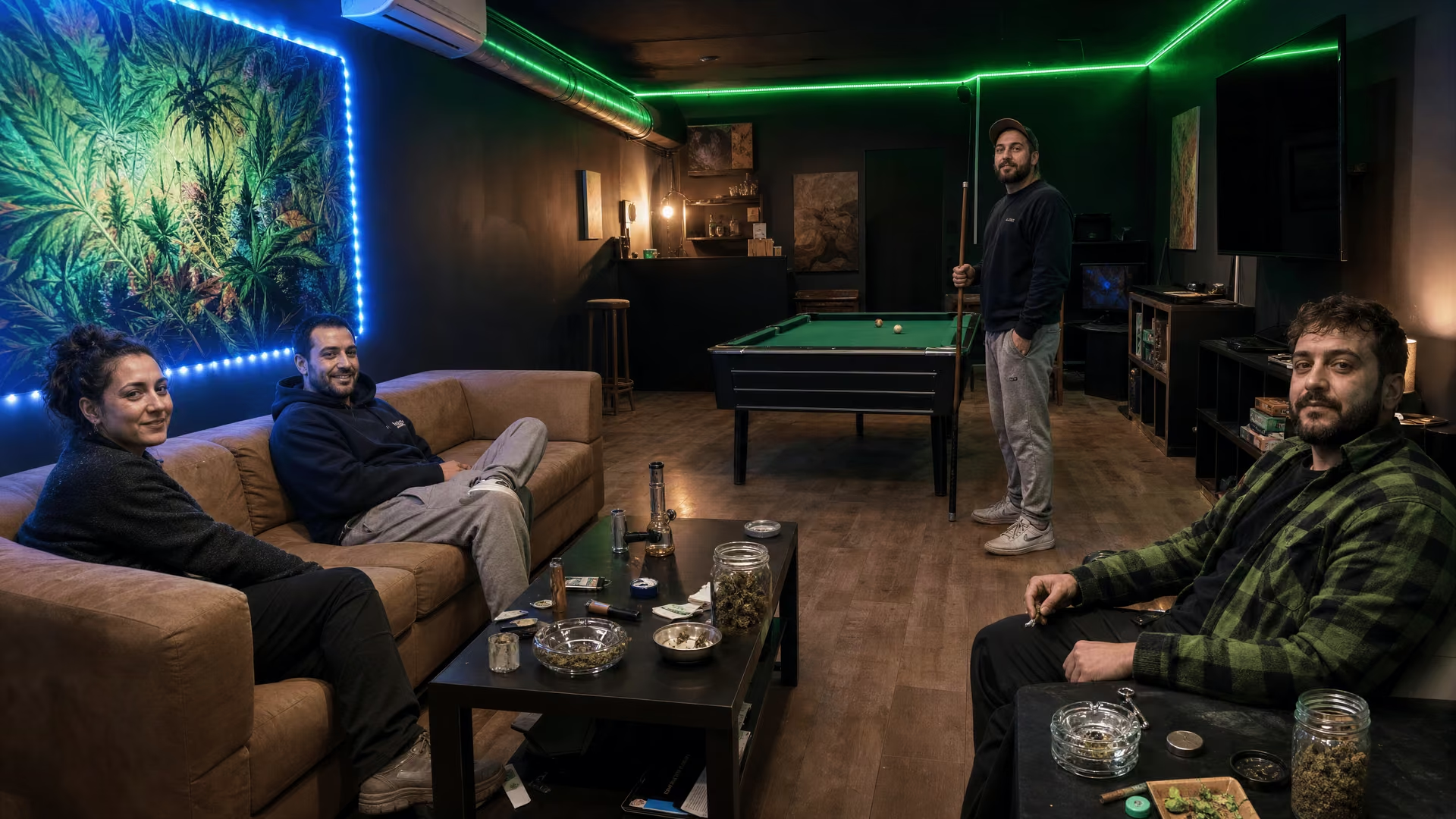
Inside a private association, the social texture is usually more important than visual branding. The room may not be designed to announce itself from the street or resemble a polished retail environment — once inside, attention tends to move away from signs and displays and towards the people sharing the space. Low lighting, sofas, shared tables, noticeboards and quiet conversations can make a room feel closer to a members' common room than to a shop. Some spaces include gardens or terraces; others are entirely indoors. There is no single visual template for a Mallorca association, and the physical setting can shape the character of the visit as much as the people in it.
A room organised around staying, not browsing
In a retail setting, the main action is generally looking at products, making a choice and leaving. A private association can feel slower and more shared. This does not mean every member is expected to socialise continuously — a private room can accommodate different levels of engagement. One person may be talking with others; another may be listening to music, reading a notice or sitting quietly. Being in a shared space does not require performing sociability.
The tone changes with the day: a quiet weekday room and a busier weekend gathering can feel like different expressions of the same association. On a quieter day, the dominant impression may be low voices and unhurried conversations, with the association feeling like a calm meeting place. A busier gathering can make several conversations feel connected at once, more animated without losing its private, member-oriented character. Daily atmosphere is part of the association's character, not a fixed feature visible in a photograph.
Conversation beyond cannabis
Members may talk about music, football, food, art, island life and local events alongside cannabis culture. Cannabis may be part of the setting, but it does not have to be the only topic at every table. Not every member will share the same interests, and not every conversation will suit every visitor — that is normal in a shared room. The atmosphere is collective, but participation can remain personal. Someone interested in one subject may find one conversation; others may prefer to observe the room without joining in.
Palma's city-facing centre
Palma's urban scale gives the island's club culture a distinctly city-facing centre — it is Mallorca's capital and largest urban centre, with a substantial resident population, which supports a varied evening life while the association model keeps each club's identity relatively self-contained. A room may feel connected to the city through its members and conversations, while still maintaining its own boundaries and identity. The city-facing character should not be mistaken for uniformity: an association in Palma can have its own pace and sense of place even though it exists within the largest urban centre on the island.
A first impression of a private association is useful, but it is only a snapshot — atmosphere is changeable, so a single visit should not be treated as a complete profile. A busier space does not automatically require constant participation, and a calm space does not automatically signal a lack of community. The most accurate picture is a flexible one: a private, member-oriented setting whose character comes from its layout, its regular users and the rhythm of the day.
What happens at reception?
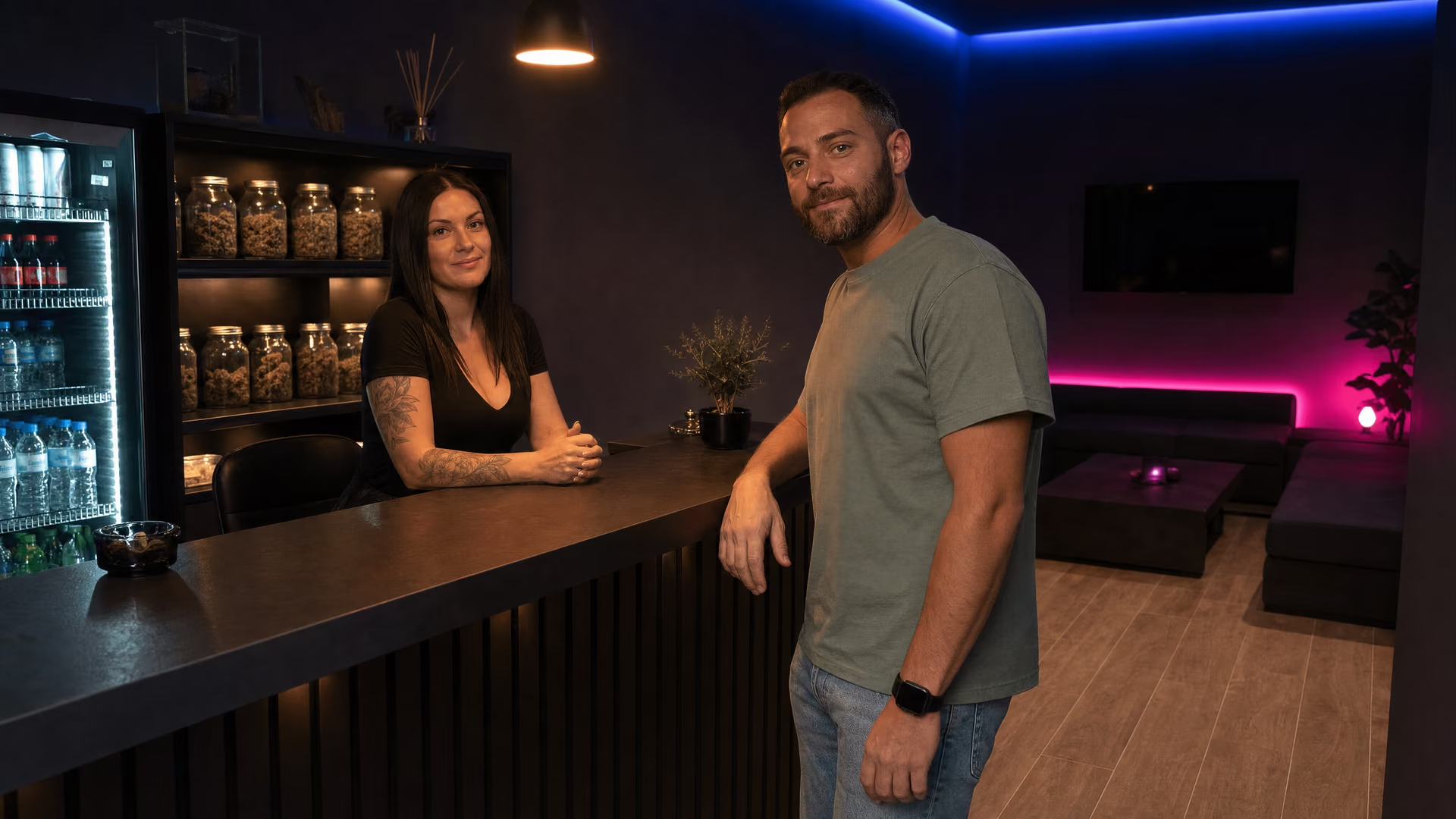
A first visit generally begins at reception or another designated check-in point, rather than with a self-service display or an immediate move into the lounge, or an informal walk straight into the main room. This first exchange gives the association an opportunity to establish who is arriving, check that the visit matches its records and explain how the space is used. For the visitor, it is the moment to slow down, listen and ask for clarification before going further inside. The first moments can feel more administrative than social — a member may be asked to confirm identity, complete a form, review house rules and wait while the association records the membership. The exact sequence varies from one association to another, and it may take longer when staff are busy.
The check-in sequence
Follow the instructions supplied before you set out. If the association has given you a particular entrance, meeting point or arrival procedure, use that information rather than assuming that every door leads into the member area. The association may compare the applicant's name with a prior registration and inspect identification — this does not necessarily make the interaction lengthy, in some cases the details can be confirmed quickly. In other cases the process may be appointment-based, so reception follows a previously arranged time rather than an unplanned walk-in.
There may be a short conversation before anything else happens: staff may confirm your details, check that the information you provided matches the association's records, or ask you to complete missing parts of a form. This is not necessarily a sign that something is wrong — the association may simply need to finish its membership record before you enter. If you are unsure what a question means, ask for clarification instead of guessing. Have the information requested in advance available and allow time for the process to finish; trying to hurry the person at reception, interrupting while they are dealing with another member, or treating the questions as an obstacle can make an ordinary check-in unnecessarily uncomfortable.
Forms, house rules and waiting
A form may cover membership details or other information the association needs on record — read it carefully before completing it, and treat the house rules the same way. They are not background text to sign without reading: they explain the conduct expected inside the space and give an early sense of how the association operates. Rules may be explained verbally, in writing, or both; if staff take you through them, listen before moving on to the social part of the visit. You may need to understand where members are expected to sit, how privacy is treated or what behaviour is considered inappropriate. Knowing the house rules before settling in is part of arriving properly, not an optional extra.
There may also be a wait while the association records the membership. A busy reception does not necessarily mean the visit will not happen, but the process may not be immediate — keep the entrance clear, wait where staff direct you, and avoid creating pressure for the person dealing with the paperwork. If you have an appointment or another commitment afterwards, leave enough time for this possibility. Use the waiting period to check that you have understood the basic information; if you were given instructions before arrival and something appears different at the door, ask a staff member calmly.
Reception is also typically where house rules and the boundaries of private areas are explained: which rooms are available to members, which spaces are restricted, and how visitors are expected to move through the premises. These instructions are part of the check-in, not an optional formality, and paying attention here prevents an otherwise avoidable mistake once you have entered the shared space.
Moving into the shared space
Once the arrival formalities are complete, the space may include a lounge, shared tables, a garden or terrace and spaces for conversation — closer to a private social environment than a transaction point. A staff member may explain the association's customs or give a brief orientation rather than a lengthy introduction; listen to what is said and ask concise questions if something remains unclear. Staff guidance helps you understand that particular association's customs, but it does not replace instructions supplied in advance — if the two seem inconsistent, ask rather than guessing.
Give yourself time to adjust before deciding where to sit or how long to stay. A person may find people talking around a table, using a lounge area, or spending time quietly elsewhere; there is no need to treat every available seat or area as open to everyone. Staff instructions and the privacy of other members take priority. Members are expected to keep voices considerate, respect staff instructions and avoid disturbing people using the room as a social environment — being aware of volume and leaving enough space for others to use communal areas comfortably. The room should be treated as a private shared setting, not a public venue: you do not need to force conversation or make yourself the centre of attention.
Responsible consumption is a straightforward part of respectful conduct here too: pay attention to your own limits and the comfort of people around you, rather than allowing consumption to become disruptive. The point is not to turn reception into a lecture or the lounge into a performance — it is to treat the setting as a shared environment in which personal choices should not create discomfort for staff or other members. If the association gives instructions about where members may sit or what conduct is expected, follow them even if the room feels informal — a short question at reception is preferable to guessing in a private area.
Privacy inside the club
Privacy continues once you are inside: conversations, registration details and anything seen during a visit should not be repeated casually to people who are not involved. Keep personal conversations discreet — members may not want to be identified, overheard or included in someone else's account of the visit, so avoid asking intrusive questions about other people. You can be friendly without requesting personal details, pressing someone to explain why they are there, or assuming that everyone wants to socialise in the same way.
A club's interior should not be treated as a photo backdrop. Do not photograph other members without permission — avoid turning shared tables, lounges, gardens or terraces into scenes for personal photography, particularly when other people or their belongings could appear. Even a casual image taken in the background can include people who did not agree to be recorded. Put the phone away when staff are explaining the rules, and do not turn the shared space into a backdrop for personal content. If there is any uncertainty about whether an image or recording is acceptable, resolve it at reception before doing it, not after — do not assume that an apparently empty corner is available for that purpose.
Arriving with somebody else
Do not assume that a friend can enter with you. A person accompanying you may not have the same membership status or may need to follow a separate procedure — ask the association in advance about anyone who intends to arrive with you, and follow the answer you receive. This matters especially if the person is waiting outside, planning to meet you later, or expects to enter only briefly.
Do not bring strangers into a members-only space. An introduction made at the entrance does not automatically make an unplanned guest appropriate, and a person you have just met should not be treated as though they are already part of the association. If someone asks to come in with you, direct them to the association's own procedure instead of promising access — you do not control the entrance, and trying to persuade staff to make an exception can put both you and the association in an awkward position. A polite explanation that the space has its own membership process is enough.
The first visit is not a test of how quickly you can understand every custom. It is an opportunity to observe, listen and behave considerately: complete the required steps, read the rules, accept that waiting may be part of the process, and avoid treating a private association as a public attraction. Respectful arrival protects the character of the shared space and makes the practical side of joining easier for everyone.
Is cannabis legal on Mallorca?
Private, yes. Public, no. Spain has never legalised recreational cannabis sale. What it has instead is a decades-old legal distinction between private and public: what an adult does with cannabis inside their own private space, or inside a private members' association, falls outside the criminal law that governs public drug offences — consumption and possession in a genuinely private setting are, in effect, decriminalised. The moment cannabis crosses into a public space — a street, a beach, a bar terrace, a hotel corridor, a rental car — administrative sanctions apply. That single line, private versus public, is the entire answer to "is weed legal on Mallorca". Everything else is detail underneath it.
The law behind it
The law that punishes public cannabis use in Spain is Organic Law 4/2015, widely known as the Ley Mordaza ("gag law"). It is not a criminal statute — it is an administrative public-order law, which is why getting caught with a joint on a Palma street results in a fine for a first, personal-use offence, not an arrest or a criminal record. Public consumption or possession is classified as a serious infraction, with fines ranging €601 to €30,000 depending on the quantity involved and the circumstances. Larger quantities, or anything suggesting an intent to sell, move a case out of administrative-fine territory and into the Criminal Code, which carries real prison exposure.
Why the association model is tolerated, not licensed
The cannabis social club — asociación cannábica — is the only route Spain tolerates for consuming cannabis in an organised, semi-collective setting: private, non-profit associations where members collectively grow and share cannabis for their own consumption on association premises. The legal foundation is genuinely contested, and that matters for what you should expect as a visitor. In 2018 the Spanish Constitutional Court struck down a Catalan regional law that had tried to formally license and regulate cannabis clubs, ruling that regulating cannabis is a matter of exclusive national, not regional, competence. That ruling did not make clubs illegal — it removed the one piece of formal regional licensing infrastructure that existed, and pushed the whole model back into the same tolerated-but-unregulated grey zone it operated in before. In practice, clubs across Spain — including on Mallorca — continue to operate as registered non-profit associations under general Spanish association law, relying on decades of private-consumption case law rather than any specific cannabis-club statute.
"Not like Amsterdam" — no legal retail exists
This is the single biggest misconception tourists bring to the island, and it deserves to be stated plainly: there is no licensed, government-approved recreational cannabis retail anywhere in Spain. Unlike the Netherlands' coffeeshop system — a tolerated but formally licensed retail model — Spain has never legalised or licensed a single point of recreational sale. No shop can legally sell a joint, a gram or an edible over the counter, on Mallorca or anywhere else in the country. If a website, a street tout or a "coffeeshop" sign implies otherwise, it is operating illegally and outside any regulatory oversight.
What a visitor actually needs to know
- Balconies and terraces are not private in practice. Smoke and smell travel to neighbouring balconies and the street, and almost every hotel and short-term rental contract in Spain explicitly bans drug consumption on the property regardless of what the law tolerates — a smoke-alarm activation or a neighbour's complaint can turn a private situation into a documented incident fast.
- Do not drive after consuming. Spain runs one of the strictest roadside drug-testing regimes in Europe; a saliva swab detects THC metabolites, not impairment, so a positive result is a positive result regardless of how long ago you consumed or how you feel. It is prosecuted under traffic-safety law, separately from the fines above.
- Do not take cannabis home with you. Whatever tolerance exists on the island ends completely at the border. Taking cannabis out of Spain in luggage is a customs and international drug-trafficking matter, checked by X-ray and dogs at the airport and ferry terminals — this applies however small the amount.
- Street dealers, beach sellers and WhatsApp "delivery" are not a legal shortcut. These operations are not licensed, not legal and not accountable to anyone — a polished-looking listing or a high review count is not a legality signal, and using one carries both legal exposure and no product-quality guarantee.
For the complete legal treatment — the exact statute, the full fine schedule, what actually happens if you are caught, and how enforcement differs by resort — see our dedicated legal guide to cannabis on Mallorca.
What NOT to do
A short list of the mistakes most likely to get a visitor refused at the door, or to sour an otherwise good evening. A negative answer is a complete answer.
Do not treat an association like a public shop
The first mistake is approaching a cannabis social club as though it were a walk-in retail counter. An association is a private setting with its own membership process, expectations and boundaries. A casual "Can I buy something?" approach can create the wrong impression before anyone has had the chance to explain whether the association can accept your enquiry. Keep the first contact factual and respectful — ask how the association wants prospective members to proceed, then follow that process rather than trying to bypass it. Do not assume that being in the same neighbourhood, seeing a sign, or hearing about the place from someone else means that entry is available immediately.
Do not use intermediaries to arrange entry
Do not ask a driver, street promoter or an unrelated bar, restaurant or nightlife venue to arrange entry for you. These people and businesses may have no connection with the association, and putting them in the middle can expose you to inaccurate information or an uncomfortable approach. If you need information, use the association's own current contact route. Avoid handing personal details to someone who merely claims to know where the association is — a recommendation from another person may help you decide what to investigate, but it should not replace direct confirmation from the association itself.
Do not rely on an old address or an unconfirmed account
Addresses, contact details and social-media profiles can become outdated. A page may remain visible even when its information is no longer current, and an address copied into a map, message or travel note may not reflect the association's present instructions. Never treat an old listing as confirmation that the place is operating, accepting enquiries or using that location. If the information conflicts, do not guess which version is correct and do not ask unrelated businesses to resolve it — pause the visit and seek current, direct clarification instead.
Do not arrive unprepared
Do not turn up without the identification or appointment information the association requested. Preparation is not about creating a performance at the door — it simply prevents an avoidable refusal or a confused conversation. Check the instructions before leaving, allow time to find the confirmed location, and make sure the information you provide matches what you were asked to provide. If you cannot meet the stated arrival requirements, contact the association before travelling rather than hoping the issue can be sorted out on arrival.
Do not turn reception into an argument
A refusal at reception may feel frustrating, particularly after you have travelled to the location. It is still not an invitation to argue — the person receiving you may be unable to accept an application, unable to verify the information provided, or following a process they cannot change at the door. Respond calmly, ask only what clarification is appropriate, and leave if the association cannot proceed. Do not raise your voice, block the entrance, threaten to complain, or demand that staff make an exception. Once the answer is no, the correct next step is to leave calmly.
Do not photograph people or private rooms without permission
A private association is not a sightseeing backdrop. A quick phone photo can include people in the background, identifying details, private conversations or information that others did not agree to share. Put the phone away unless photography has clearly been permitted; if you want to take a picture of a particular room, object or activity, ask first and accept the answer without pressing for an explanation. Privacy is part of the setting, not an optional courtesy.
Do not pressure other members
You do not need to know how someone joined, what they use, where they live, or why they are present. Do not ask for another member's contact information, insist on seeing what they have, or treat a friendly conversation as permission to request a share. Take a no at face value and give the person space rather than asking the same question in a different way — a respectful visit leaves other people in control of what they disclose.
Do not bring public nightlife behaviour into a private room
Do not carry the atmosphere of a loud nightlife venue into a quiet private room — that means avoiding shouting, disruptive music, aggressive joking, unwanted attention and behaviour that makes it difficult for others to relax. Notice the room before joining in, keep your voice and movement suited to the atmosphere, respect personal space, and follow any directions given by staff. Match the room rather than making the room match you.
Do not consume in public or while travelling
Do not consume in public spaces or transport settings. Keep the boundaries of the private setting clear, and do not treat a pavement, station, vehicle or other shared travel environment as an extension of the association. Do not drive after consuming cannabis, and do not combine it with alcohol when that could impair judgement — plan your movements so that you are not making a decision to drive or travel while impaired.
Do not leave cannabis or related items accessible
Do not leave cannabis or related items where children or other people can access them, including unattended in a shared room, an open bag, a vehicle, or another place where someone could handle them without your knowledge. Anything you cannot keep under your control should not be left unattended.
When in doubt, stop rather than improvise
Most of these mistakes begin with an assumption: that an old address is still valid, that a third party can arrange entry, that a photograph will not matter, or that a refusal can be negotiated. Replace those assumptions with a simple sequence: confirm current information directly, bring what was requested, ask before crossing a privacy boundary, and leave calmly if the association cannot proceed. A delayed visit is preferable to arriving unprepared, involving unrelated people, or creating pressure for staff and members.
Good etiquette, stated positively
Good etiquette is quiet, practical and reciprocal. A club is easier for everyone when members understand that access to a private association involves cooperation, not just a quick transaction. Bring the identification and confirmation requested by the association, arrive during the agreed appointment window, listen to reception staff and read the house rules before settling in — every association may organise contributions and rules differently, so do not copy what happened elsewhere or pressure staff to reproduce another club's method.
Keep shared areas tidy as you use them — put items where the house rules indicate, clear away anything you have brought into a communal space, and leave the area ready for the next person. Members should avoid unwanted conversations and treat staff as hosts rather than retail workers: give them time to finish explaining a process, speak directly and politely when you need clarification, and accept an answer without turning the exchange into an argument if a request cannot be accommodated. With other members, let conversation develop by consent — if someone gives short answers or turns away, end the exchange rather than trying to keep it going, and do not use the club as a stage for attention-seeking behaviour.
A club is not a nightlife venue
A cannabis social club is also not automatically a nightlife venue, even though it sits within Palma's wider social landscape of restaurants, music venues and waterfront streets. A bar or music venue is usually a public stop that can be added spontaneously to an itinerary; an association is a private, members-only environment whose access, conduct and atmosphere depend on its own arrangements. Someone looking for a lively place to continue a night may arrive expecting constant activity, loud music or an open-door flow of visitors — the association may instead offer a room where members talk, spend time at a relaxed pace and follow house rules. A social setting is not necessarily a nightlife setting.Let the room set the pace instead of trying to create a nightlife mood that is not already there, and treat noise, photography and the presence of non-members as house-rule matters rather than nightlife habits.
Public streets, transport, beaches and plazas are separate from the private association environment. The club's interior should not be carried into public life as a performance or invitation. A considerate member leaves without drawing attention to the association or its members, keeping other people's privacy intact and making it easier for the next member to have a quiet, respectful visit too.
What changes with the seasons?
Mallorca's rhythm changes sharply between the busy summer period and the quieter months, and Palma remains active outside the peak while coastal areas can feel much busier during the main visitor season. Association responses, appointment availability and reception arrangements may also change with staffing, holidays or local demand. For a visitor, seasonality is not only a question of whether an area feels lively — it can affect the practical sequence of making contact, arranging a visit and confirming that the reception process is still the same. A listing may be visible when you begin planning, but the useful question is whether the association can respond and receive you at the time you actually intend to go.
Summer and the busier period
In the busy summer period, resort areas may feel more active and travel plans can be less forgiving. A route that looks straightforward on a map still needs to be considered alongside the time of day, the part of the island where you are staying and whether you are relying on walking, public transport or a car. Do not treat a short map distance as a guaranteed short journey, particularly when your visit depends on an appointment or a specific reception arrangement. Increased demand may also mean that replies take longer, appointments are arranged differently, or reception is handled on a narrower schedule — an association with more enquiries does not necessarily have more availability.
Planning also matters because summer activity is unevenly distributed: Palma's central districts remain active across the year, whereas resort areas can feel more seasonal. That means the place where you are staying may have a noticeably different rhythm from the capital, even during the same week. If you are visiting during the busier period, check the practical details before setting out — confirm the current opening arrangement directly, allow time for the journey, and keep the municipality in mind when comparing listings. Seasonal busyness can affect the journey and the pace of a visit, but it does not create a universal membership schedule.
What the quieter months feel like
The quieter months can produce a different kind of visit. Resort areas may feel less crowded and local social life may move at a slower pace, while Palma's central districts continue to provide activity across the year. This should not be read as a promise that every venue is operating in the same way outside the busy period — instead, it is a reason to check the current arrangement rather than relying on an assumption based on a previous trip or on the general character of the area. A quieter period may also be affected by staff holidays or changed arrangements even where the surrounding area feels easier to navigate.
There is no single island-wide point at which the season changes. Use the season as a planning signal, not as a substitute for checking the individual association. Current opening arrangements should always be confirmed directly, whether you are travelling in the busy period or the quieter months.
Outdoor and indoor social spaces
Weather can influence the atmosphere of a visit without changing the basic nature of the association. Warm evenings may shift social life towards terraces and gardens where an association provides them; cooler months can make indoor lounges more central. These are atmosphere differences, not guarantees about any particular club — the availability of a terrace or garden depends on the association and its premises. If the setting is important to your plans, ask directly rather than inferring it from photographs, a neighbourhood description or the season.
Plan around confirmation, not assumption
If your visit depends on an association being available, treat the directory as the starting point for a short confirmation process: review the listing and note the contact route, make contact early enough to allow for a delayed response, and check the practical details again before setting out, particularly near a holiday period, during a busy coastal season, or after a long gap since the listing was last reviewed. Confirmation is what turns directory information into a usable plan.
- Check the listing before travelling rather than relying on a saved screenshot.
- Allow time for the association to respond, especially when demand may be higher.
- Ask whether reception is available on the day and at the time you have in mind.
- Confirm any appointment or arrival instructions shortly before leaving.
- If there is no response, avoid treating silence as an invitation to arrive without notice.
Travel time is part of seasonal planning
Public transport, walking routes and road conditions vary by location, and a club in Palma is not automatically convenient for someone staying in Alcúdia, Cala Millor or Cala d'Or. Before travelling, identify the municipality first, then compare it with your accommodation and the transport method you intend to use — if the route involves walking, check the complete route rather than the straight-line distance; if using public transport or driving, allow room for the route being less direct than it appears. These checks become particularly valuable when your timing is tied to an appointment or when travelling during a busier period. The directory describes a wider island scene; your journey still begins from one specific place.
Getting to an appointment
Palma's airport is the island's principal arrival point. From there, journeys vary considerably depending on the destination, traffic and season, and a district name alone is not enough to plan a precise route. Treat the airport as the start of a short planning process rather than the place to make the final decision about how to travel — before leaving the arrivals area, check the association's latest message, the meeting address and any instructions about the entrance.
Plan the journey in stages
A reliable plan separates the journey into three stages: reaching the right part of Mallorca, finding the precise meeting point, and allowing time to arrive calmly. These stages matter because a route can look straightforward until the final part — a district, neighbourhood or municipality may cover more ground than its name suggests, and a map result may not identify the entrance the association actually uses. Write down the complete destination as it was supplied to you: street, building detail, floor or door, and the contact method to use on arrival — do not replace it with a shortened map label. Screenshots or copied directions can be useful if reception becomes unreliable, your phone battery is low, or you need to compare two route options while travelling.
Do not schedule an appointment immediately after landing. Registration and orientation need their own time allowance, especially with luggage, an unfamiliar area, or a discrepancy between the address on your phone and the association's directions. A better sequence is to confirm the appointment before departure, arrive at the airport, check your messages and route, and then begin the journey with a buffer.
Confirm details before travelling
Keep the association's current contact details available throughout the journey — not to call repeatedly without a reason, but to have a dependable way to ask a concise question if the meeting information changes. Confirm the date, time, destination and any arrival instruction before you set off, particularly when the booking was arranged some time earlier. Do not rely on a map pin if the association has supplied different directions — a pin can place you near a building while still leaving the wrong entrance, street side or access point unresolved. If your arrival is delayed, contact the association as soon as the delay becomes clear and give a realistic estimate rather than promising an arrival time you cannot meet.
Choosing between transport options
Public transport, taxis and private vehicles each have different practical considerations across Mallorca. The right choice depends on the destination, the time of day, the season, the amount of luggage and how much uncertainty you are prepared to manage during the final part of the route. For public transport, check the route close to the day of travel rather than relying on an old timetable, and confirm the departure point, changes, destination and the amount of walking at each end. A taxi reduces the number of changes, but you still need the association's full address and contact details ready to show or read out to the driver. Private vehicles bring their own considerations — check the route before departure, allow for traffic and season, and remember that parking and the walk from the vehicle are part of the journey even once the map suggests you have arrived.
Plan the return journey before the appointment
The return journey deserves the same attention as the outward trip. Before the appointment begins, know how you intend to leave and whether you need to arrange a pickup, check a later connection or keep a phone charged for the journey. If cannabis has been consumed, do not drive. Plan a sober route and treat the return journey as part of responsible planning — that may mean arranging transport that does not require you to operate a vehicle, travelling with someone who remains sober, or postponing travel until you can do so safely. Do not make that decision at the last moment, when tiredness, uncertainty or pressure to get home can narrow your choices.
Practical tips for a visitor
A little preparation avoids most avoidable problems, and Mallorca is an island — a journey to an appointment can require more planning than a short walk to a nearby venue.
- Bring the identification the association has asked for, and do not assume a different document will be accepted on the day.
- Allow more time for the journey than a map distance implies, especially between Palma and a resort municipality, and especially during the busy summer months.
- Keep any confirmation message the association sends you — an appointment time, a registration acknowledgement — so you can show it if asked.
- Check separately whether a companion can be admitted. One person's registration does not extend automatically to another.
- Ask first if anything is unclear — an introduction requirement, an accepted document, an opening time. A short question in advance is far more useful than an assumption discovered at the door.
- Confirm the payment method before travelling; cash-only is common at some associations.
- Do not rely on an old post, screenshot or forwarded message as proof that an association is currently accepting new members — ask for the current situation directly.
- If travelling from a resort to Palma or vice versa, build in a wider margin during the summer months, when roads and public transport are busier than the rest of the year.
- Plan a sober way home in advance if you expect to consume during the visit — arrange it before the appointment, not after.
- Keep a record of when an association confirmed a detail — a fee, a document, an appointment — and check again if your visit is arranged well after that confirmation.
Responsible use
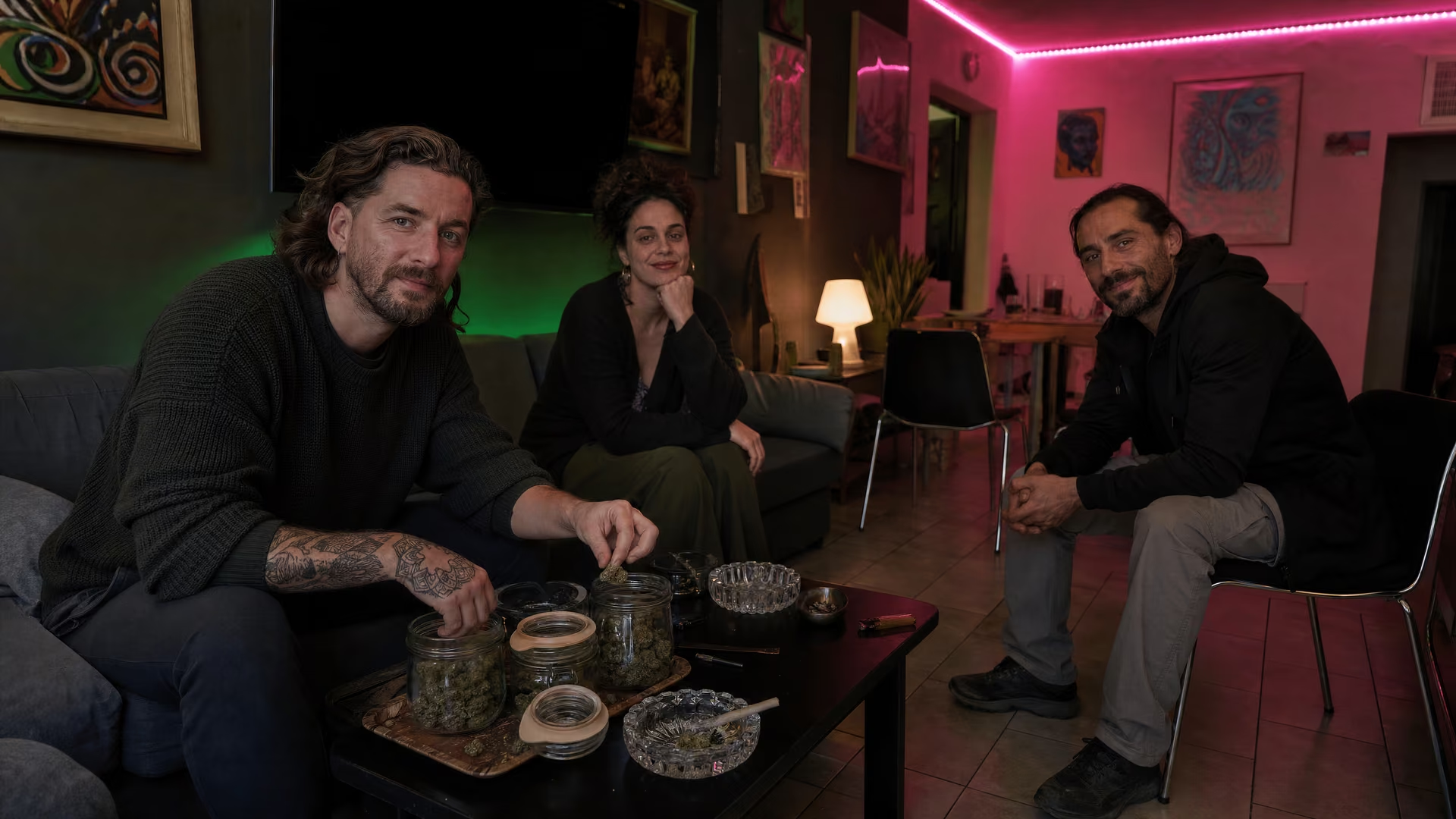
Responsible consumption is part of the house-rule framework at every association, not an afterthought — members are expected to know their own limits and to consider the people around them, and staff instructions on this point take priority over personal preference. Pace yourself, especially with edibles, which take far longer to take effect than smoking and are the most common way a first-time visitor overdoes it, and never mix cannabis with driving (see the legal section above) or with alcohol in a way that impairs your judgement. For the fuller harm-reduction picture and emergency contacts, see our dedicated safety and harm-reduction hub before your visit, particularly if this is your first time in a club setting.
Practical questions before you go
What is actually available inside?
Because there is no legal recreational retail channel, an association does not operate a public product menu the way a shop would — what is available is part of the association's own collective-cultivation or shared-supply arrangement among its registered members, and it is set by that association, not published as a catalogue on any listing. Some associations may describe a broad cannabis culture — strains, flower, hash, concentrates, edibles — as part of ordinary member conversation, but a mention of a category is not a promise that it is currently available. Ask the association directly what its members can expect once registered, rather than treating any online description as an inventory.
Opening hours — when to go
There is no single island-wide schedule to publish here, and printing one would be exactly the kind of figure that goes stale the moment an association changes it. Many associations keep afternoon and evening hours rather than staying open around the clock, and some operate on an appointment-only basis with no walk-in hours at all. The figure block earlier in this guide gives a live, aggregate picture of typical hours across the region's active clubs — but the current opening arrangement for the specific association you are contacting should always be confirmed directly, as covered earlier in this guide.
Do I need to be a resident?
No. Residents, workers and visitors spending time on the island may all ask about membership — being a tourist does not disqualify you. What differs is not eligibility by residency status but what each individual association asks of an applicant: some associations may be more geared towards people who can attend in person repeatedly, while others are set up to receive visitors on a single trip. The honest answer is that residency is not the gatekeeping factor; the association's own current process is.
Age limits, stated plainly
Membership spaces are adults-only, 18 and over, across the board — that is the floor everywhere on the island. A number of associations set the bar higher, at 21 and over, as part of their own house rules. There is no way to know which threshold a particular association uses without asking, so confirm the minimum age when you make contact, particularly if you are travelling with a younger adult companion.
Can I bring someone with me?
Not automatically. Membership is personal, so a companion generally needs to go through the association's own application process rather than simply accompany an existing member — this is covered in full under "Arriving with somebody else" earlier in this guide. The short version: ask the association about your companion before you travel, do not assume an unregistered guest will be admitted, and treat each person's admission as a separate question.
How long does membership last, and does it transfer?
Renewal practices vary by association — some describe membership as ongoing with a periodic renewal, others frame it differently — and there is no single island-wide term to state here. What is consistent is that membership does not transfer between associations. Being accepted as a member of one club says nothing about whether another club will accept you; each association runs its own registration and makes its own decision, so a membership card from one association should never be assumed to have any standing at a different one.
What if I'm refused?
An association may decline an application without giving the same explanation another association would give, and that is within its discretion — a refusal at one club does not establish a rule for the island. Common, ordinary reasons include incomplete or unaccepted identification, arriving without a required appointment or introduction, or simply an association not currently accepting new members. If you are refused, the correct response is to leave calmly and, if you want to try again, do so with current information rather than an argument (see "What NOT to do" above). A refusal at one association is not a verdict on your eligibility elsewhere.
Payment — cash or card, in practice
Some associations accept cards or transfers; a number operate cash-only. There is no island-wide standard, so — as covered in "Costs and contributions" above — confirm the accepted payment method directly with the association before travelling, particularly if your visit depends on a specific amount being ready on arrival.
Will they speak English or German?
It varies by association, and there is no guarantee either way — some associations are comfortable in English or German given the island's visitor mix, others operate primarily in Spanish or Catalan. If language is a concern, ask when you first make contact, in the language you are most comfortable using, and see how the association responds; that first exchange is itself a reasonable indication of how the visit will go. This is also one of the practical gaps a Fast-Track pass is built to close, since the introduction and registration steps are handled on your behalf in advance.
Frequently asked questions
What is a cannabis social club on Mallorca?
It is a private, members-only, non-profit association with its own house rules and registration process. It is not a coffee shop or a dispensary.
How do I join a cannabis club on Mallorca?
Contact an association, review its process, complete any registration form, arrange an appointment when requested and bring accepted photo identification. An invitation or referral may be part of the process, but acceptance is always decided by the association.
Are Mallorca cannabis clubs adults-only?
Yes. These are adults-only spaces, with members described as 18 and over. Identification may be requested during registration or at reception.
Do I need an invitation or referral?
Some associations use an invitation, referral, sponsoring member, QR code or written introduction, while others explain a different application process directly. There is no single island-wide procedure.
What should I bring to membership registration?
Bring the identification requested by the association, such as a passport or national ID card, along with any appointment confirmation or invitation. The association explains its own documents and registration steps.
Is a Mallorca cannabis social club like an Amsterdam coffeeshop?
No. A Mallorca cannabis social club is a private association rather than a public-facing coffee shop. Search terms such as "coffeeshop Mallorca" can be misleading because the formats are different.
What does membership usually involve?
A registration form, an annual membership fee or shared-cost contribution, sometimes a membership card, and acceptance of the association's house rules. Details vary by association.
How much does membership cost?
There is no reliable island-wide figure — fees, contributions and payment methods are set by each association individually. Ask directly what a quoted amount covers and whether payment is cash-only before travelling.
Can I bring a friend or partner with me?
Not automatically. Membership is personal, so a companion generally needs to follow the association's own application process rather than simply accompany an existing member.
Can I walk into a club without registering?
No. These are private, members-only associations rather than walk-in public venues. Reception procedures, appointments and guest policies vary, so current arrangements must be confirmed with the association.
Where are clubs located on Mallorca?
Palma is the island's principal urban base, but Mallorca is geographically dispersed. Palma districts and resort areas such as Magaluf, Santa Ponça, Alcúdia, Cala d'Or and Cala Millor should be treated as separate locations.
Does the club scene change with the seasons?
Yes. Resort areas are busier in summer and quieter outside it, which can affect journey times and how far ahead to plan — Palma's central districts stay active year-round. Always confirm an association's current opening arrangement directly rather than assuming a seasonal schedule.
How current is the Mallorca directory?
Listings are updated over time, but association status, contact details, membership criteria and opening arrangements can change. Verify current information directly before relying on a listing.
Do I need a Fast-Track pass to join a club?
No — but going it alone is genuinely harder than it sounds, and this page has already shown you why. Each association sets its own intake and entry is solely at its discretion; most expect contact before you arrive, and some require a referral from an existing member. A first message is not an acceptance — it only opens a conversation, and replies can be slow or never come, which is a real problem for a visitor with a handful of days on the island. Language, opening hours and whether an association is taking newcomers at all vary from one club to the next, with no island-wide answer to any of them. If you would rather have the identification and registration steps arranged in advance, the single-club Fast-Track pass does exactly that. It is still not necessary for everyone — a longer-staying visitor who is comfortable contacting an association directly and can absorb a slow reply does not need it.