


Short answer: cannabis is not legal to buy, sell or smoke in public anywhere on Mallorca (Majorca) or the rest of Spain — but it also isn't treated like a hard drug. Spain runs on a private/public split that trips up almost every tourist: what happens behind closed doors inside a registered Cannabis Social Club (CSC) is tolerated, while the exact same joint on a Palma street, a Magaluf balcony rail, or an Alcúdia beach can get you fined €601–€30,000. There is no open-door coffeeshop model here, no licensed dispensary, and no shop where a tourist can walk in and buy weed over the counter. This guide explains exactly where the line sits, cites the actual Spanish law behind it, and tells you what to do instead if you want legitimate, honest access during your stay.
The Short Answer: Private, Not Public
Spain has never legalised recreational cannabis sale. What it has is a 40-year-old legal grey zone built on privacy, not permission: Spanish courts have repeatedly held that what an adult does with cannabis inside their own private space, or inside a private members' association, falls outside the criminal law that governs public drug offences. Consumption and possession in a truly private setting are effectively decriminalised. The moment cannabis crosses into a public space — a street, a beach, a bar terrace, a hotel corridor, a rental car — the calculus flips and administrative sanctions apply.
That single distinction — private versus public — is the entire answer to "is weed legal on Mallorca". Everything else in this guide is detail underneath that line.
The Actual Law: Organic Law 4/2015 (the "Ley Mordaza")
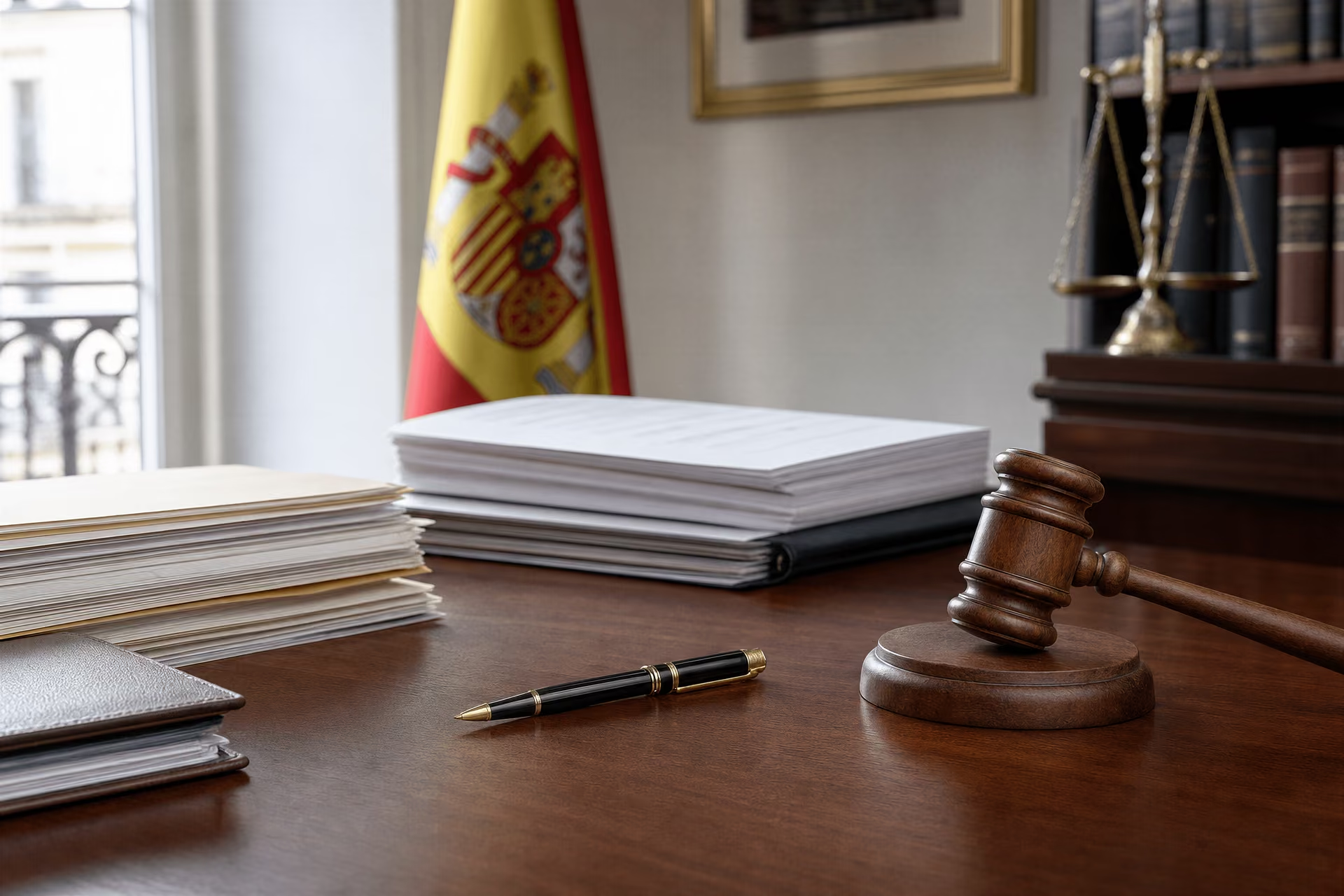
The law that punishes public cannabis use in Spain is Ley Orgánica 4/2015, de Protección de la Seguridad Ciudadana — widely nicknamed the Ley Mordaza ("gag law"). It is not a criminal statute; it's an administrative public-order law, which is why getting caught with a joint on the street in Palma results in a fine, not a criminal record or an arrest for a first, personal-use offence. The full text of the law is published by Spain's official state gazette at boe.es (BOE-A-2015-3442).
- Public consumption or possession of cannabis is classified as a "grave" (serious) infraction under Article 36.16 of the law.
- Fines range from €601 to €30,000, depending on the quantity involved and whether it's treated as simple possession/use versus something closer to trafficking-adjacent conduct.
- Around 100 grams is the informal threshold Spanish police and courts commonly use to distinguish "personal use" quantities from amounts suggestive of intent to distribute — cross into distribution territory and you are no longer in administrative-fine land, you are in the Criminal Code, which carries real prison exposure — drug-trafficking offences are set out in Article 368 of the Código Penal (Ley Orgánica 10/1995), published at boe.es (BOE-A-1995-25444).
- Growing cannabis visible from a public street or a shared building courtyard is treated the same as public possession, even if the plant itself is on private property.
This law applies uniformly across Spain — Mallorca has no separate island exemption, no relaxed Balearic version, and no tourist carve-out. A fine is a fine whether it's issued in Palma, Magaluf, or Madrid.
Cannabis Social Clubs and the 2018 Constitutional Court Ruling
The only legally-tolerated route to consuming cannabis in a semi-organised setting in Spain is the Cannabis Social Club (CSC) model — known in Spain as an asociación cannábica — private, non-profit associations where members collectively grow and share cannabis for their own consumption on association premises. The model's legal foundation is genuinely contested, and that matters for what you should expect as a visitor.
In 2018 the Spanish Constitutional Court struck down a regional Catalan law (the Catalan cannabis-club regulation passed in 2017) that had attempted to formally license and regulate these clubs, ruling that regulating cannabis falls under exclusive national, not regional, competence. That ruling did not make clubs illegal outright — it removed the one piece of formal regional licensing infrastructure that existed and pushed the whole model back into the same tolerated-but-unregulated grey zone it operated in before. In practice, clubs across Spain — including on Mallorca — continue to operate as registered non-profit associations under general Spanish association law, relying on the private-consumption doctrine built up through decades of case law, not on any specific national "cannabis club statute" (because none exists).
What this means for you as a tourist: a CSC is a private members' association, not a retail shop. Legitimate clubs require genuine membership — an application, ID, and (in the traditional model) a waiting period before you can collect anything, because the fiction the whole model rests on is that members are collectively cultivating for themselves, not selling to walk-in customers. Membership additionally requires being at least 18 years old — Spain's legal age for cannabis and alcohol — and there is no legal route to cannabis access on Mallorca for anyone under 18, inside or outside a club. Read what "membership" actually requires and how Fast-Track access works if same-day entry matters to you, and see the wider legal situation across Spain for how this plays out nationally.
"It's Not Like Amsterdam" — No Legal Recreational Retail Exists
This is the single biggest misconception tourists bring to Mallorca, and it deserves to be stated as plainly as possible: there is no licensed, government-approved recreational cannabis retail anywhere in Spain. Unlike the Netherlands' coffeeshop system — a tolerated but formally licensed retail model — Spain has never legalised or licensed a single point of recreational sale. No shop can legally sell you a joint, a gram, or an edible over the counter, on Mallorca or anywhere else in the country. If a website, a street tout, or a "coffeeshop" sign in Magaluf or Palma implies otherwise, it is operating illegally and outside any regulatory oversight — see the scam section below.
CBD vs THC: What You Can Actually Buy Legally
You will see "CBD shops" openly trading in Palma and the resort towns, and that's not a contradiction of anything above — it's a separate legal category. CBD (cannabidiol) products with THC content below Spain's legal limit are treated as a normal consumer good, not a controlled substance, and can be sold openly in shops, online, and in pharmacies. THC (tetrahydrocannabinol) — the psychoactive compound — is what remains restricted under the framework above. A CBD flower or oil product that tests within the legal THC threshold is fine to buy and carry; a THC cannabis product is not, regardless of which shop sold it to you. If a "CBD shop" is visibly selling strong-smelling, high-potency flower that looks and smells like standard recreational weed, treat that as a red flag, not a loophole — see the scam section.
Can I Smoke in My Hotel Room or Airbnb?
This is the practical question almost every tourist actually has, and the private/public line answers it directly. A private, enclosed space you're renting — your locked hotel room, your Airbnb apartment — falls closer to "private" than "public" under the doctrine above. But three things narrow that in practice:
- Balconies and terraces are not private in the same way. Smoke, and the smell, travels — to neighbouring balconies, to the street, to shared courtyards. Police and hotel security in tourist resorts (Magaluf, Palma Nova, Santa Ponsa, S'Arenal) are used to exactly this complaint and do act on it.
- Hotel and Airbnb rules override the legal grey zone. Almost every hotel and short-term rental contract in Spain explicitly bans drug consumption on the property, cannabis included. Breaching that is a contractual matter (eviction, loss of deposit, being reported) independent of whether the law itself would tolerate it.
- Smoke detectors and staff complaints trigger real consequences — a hotel calling police over a smoke-alarm activation converts a "private space" situation into a documented incident fast.
Practical checklist: keep it inside, away from open windows and balconies, never in shared hallways or lobbies, check your accommodation's specific house rules before you assume anything is fine, and accept that "technically private" does not mean "risk-free" — it means "lower risk if you're genuinely discreet and behind a closed door."
Driving in Mallorca After Using Cannabis — the Real Worry
This is the risk most cannabis guides skip entirely, and it's arguably the one that catches out the most tourists who rent a car on the island. Spain runs one of the strictest roadside drug-testing regimes in Europe. The Guardia Civil and local police conduct routine saliva-swab drug checks at checkpoints across Mallorca, especially around resort areas and on the roads out of nightlife zones (the Magaluf and Palma Nova strip, S'Arenal, Playa de Palma).
- The test detects THC metabolites, not impairment — a positive result is a positive result regardless of how long ago you consumed or whether you feel affected. THC can be detectable in saliva for many hours and, depending on frequency of use, for days.
- A positive roadside drug test carries criminal, not just administrative, consequences — it is prosecuted under Spain's Traffic Safety Law (distinct from the Ley Mordaza fines above), with penalties that can include heavy fines, licence suspension, and in some cases a criminal record.
- This applies to rental cars and scooters/mopeds exactly as it applies to any other vehicle — rental status is irrelevant to the police.
The safest rule: if you've consumed cannabis, do not drive on the same day, full stop. This is not a "wait an hour" situation the way alcohol sometimes gets treated informally — testing windows for THC are unpredictable and unforgiving.
Can You Take Cannabis Home With You? No — It's a Customs Offence
Whatever tolerance exists on the island for private consumption ends completely at the border. Taking cannabis out of Spain in your luggage is a customs and international drug-trafficking offence, treated far more seriously than a local public-possession fine — this applies whether you're flying home within the EU or outside it, and whether the amount is large or genuinely small. Airport security at Palma de Mallorca Airport (PMI) and ferry terminals run active drug detection (X-ray, dogs). Do not pack, carry, or attempt to mail cannabis home under any circumstances — consume or dispose of anything before you travel to the airport, not at it.
Street Dealers, Beach Sellers, and WhatsApp "Delivery" — Assume It's a Scam or a Crime
Search for cannabis delivery on Mallorca and you'll find a cottage industry of WhatsApp- and Telegram-ordered "weed delivery" operations advertising openly to tourists in Magaluf, Santa Ponsa, Alcúdia and Palma. These operations are not licensed, not legal, and not accountable to anyone — no delivery service, dispensary, or "dispensary-style" shop selling recreational cannabis to walk-in customers is operating within the law in Spain, regardless of how professional its website, star ratings, or Google Business listing look. A polished storefront or a high review count on Google Maps is not a legality signal; it just means the operation hasn't been shut down yet.
Beyond the legal exposure of buying from an unlicensed street or beach dealer (you are participating in an illegal transaction, full stop), there is a very real practical risk: no quality control, no accountability if the product is misrepresented or adulterated, and a documented pattern of tourists in resort areas being short-changed, sold fake or contaminated product, or targeted for theft during the exchange. This is the actual risk profile of "how do I get weed on Mallorca as a tourist" — and it's precisely the gap the Cannabis Social Club model exists to close.
What Actually Happens If You're Caught?
For a tourist caught with a small, personal-use quantity of cannabis in a public place on Mallorca, the realistic outcome is an administrative fine under the Ley Mordaza (see above), not arrest or a criminal charge — Spain treats this as a public-order infraction for personal-use amounts. In practice:
- Police will typically confiscate the cannabis and issue a formal notice/fine on the spot or by post to your registered address (including, for tourists, wherever they can serve it — this can complicate matters if you've already left the country).
- Fines start at €601 for straightforward cases and scale up with quantity, location (near a school, in view of minors), and any aggravating factors, up to €30,000.
- Larger quantities, any indication of intent to sell/distribute, or cannabis found alongside other substances moves the case out of administrative territory and into the Spanish Criminal Code, where the consequences are materially more serious — potential arrest, prosecution, and imprisonment.
- A drug-related arrest or charge, even a minor one, can complicate future travel to countries with strict entry requirements — worth knowing before you take a public-space risk on holiday.
Is It Different in Magaluf, Santa Ponsa or Alcúdia?
No — the law is national and applies identically across every resort area on the island. What differs by location is enforcement intensity and club availability, not the legal framework itself. Magaluf and Palma Nova, as the island's busiest nightlife strips, see the heaviest police presence and the highest concentration of both roadside drug checks and street-dealer scam activity described above. See our dedicated area guides for what's realistic in each: is weed legal in Magaluf, is weed legal in Santa Ponsa, and is weed legal in Alcúdia — each covers the local club landscape and access options for that specific area.
Frequently Asked Questions
Is weed legal in Majorca?
"Majorca" and "Mallorca" are the same island (English and Spanish/Catalan spellings) — the legal answer is identical either way: cannabis is decriminalised for private, personal-use consumption, but illegal to buy, sell, or use in any public space, and there is no legal recreational retail anywhere on the island or in Spain.
Can tourists buy weed on Mallorca?
Not from a shop or a street dealer — there is no legal retail channel. The one legitimate route open to visitors is joining a registered Cannabis Social Club as a genuine member; some clubs offer faster same-day access options. See how to buy cannabis on Mallorca the legitimate way.
Is it legal to smoke weed on the beach on Mallorca?
No. A beach is a public space under the Ley Mordaza, exactly like a street or a bar terrace, and smoking cannabis there carries the same €601+ fine exposure as anywhere else in public.
How much weed can I legally carry on Mallorca?
There is no amount that is legally guaranteed "safe" in a public space — any public possession can be fined. Around 100 grams is the informal line Spanish authorities use between personal-use administrative fines and criminal trafficking exposure, but that is a risk threshold, not a legal allowance.
Can I join a cannabis club on Mallorca as a non-resident tourist?
Yes — clubs on Mallorca do accept non-resident tourist members, though the traditional model requires a genuine membership application and, in some clubs, a short waiting period, because clubs are legally private associations, not shops. See how the club model works nationally for the full picture.
Will I get in trouble for a positive drug test while driving a rental car?
Yes, and it is treated as a serious traffic-safety offence, not a minor infraction — see the driving section above. Rental status does not exempt you from Spain's roadside THC testing.
Is there a minimum age to join a cannabis club or use cannabis on Mallorca?
Yes — Cannabis Social Clubs require members to be at least 18, the same legal age Spain sets for alcohol, and no club or private setting makes cannabis access legal for anyone younger. There is no exception for tourists.
Is cannabis about to be legalized for recreational use in Spain?
No. As of 2026 no national law legalizing recreational cannabis sale has been passed in Spain, and the private/public framework described in this guide remains the country's operative approach. There is still no shop-based recreational retail model — like the Netherlands' coffeeshops — anywhere in Spain, including Mallorca.
Want Legitimate, Honest Access on Mallorca?
The private/public line above is real, but it isn't the end of the story for a tourist who wants a legitimate way to visit a Cannabis Social Club during a Mallorca trip. Browse the 26 Cannabis Social Clubs across the island with photos, contact details and directions, or go straight to Fast-Track access if same-day entry without a long membership wait matters to you. For the wider Spanish legal picture and how THC and other cannabinoids are classified more generally, see Cannabivo's global cannabis legalisation overview.