



Quick answer: Cannabis on Mallorca is decriminalised for private, personal use but not legalised. Possessing or consuming weed in private is not a crime; any public possession or consumption — on the beach, in the street, in a car, outside a club — is an administrative offence punishable by fines from €601 to €30,000. There are no coffeeshops and no legal cannabis shops in Spain. The only legal-grey access route is the cannabis social club (CSC) — a private, non-profit, members-only asociación cannábica. This guide explains every angle: the law, the fines, home growing, driving rules, airport and ferry rules, the history, the science, the clubs, and how legal access actually works in 2026.
Important disclaimer. This page is educational information only. It is not legal advice, and nothing here is an offer, advertisement, or encouragement to buy, sell, or consume cannabis. Cannabis associations in Spain are private, non-commercial entities for adult members. Laws change and are enforced locally and at police discretion. Always verify the current law and consult a qualified Spanish lawyer before acting. Strictly 18+ / 21+.
Cannabis on Mallorca: Key Facts at a Glance
| Question | Answer (2026) |
|---|---|
| Is cannabis legal on Mallorca? | Decriminalised in private, prohibited in public. Not legalised. |
| Can I smoke in public / on the beach? | No — administrative fine €601–€30,000. |
| Can I smoke in private? | Yes — private homes and private clubs are tolerated. |
| Are there coffeeshops / dispensaries? | No — none exist in Spain. |
| How do adults access cannabis? | Private home grow, cannabis social club membership, or private sharing. |
| Can tourists join a club? | Sometimes — many require residency/ID; access is invitation-only, never advertised. |
| Club membership fee | Typically €15–€50/year (a contribution, not a purchase). |
| Can I buy on the street? | Illegal, unsafe, scam-ridden. Avoid. |
| Can I grow at home? | Small personal grow, not visible publicly, self-use only. |
| Can I drive after using? | Zero tolerance — €1,000 + 6 points; THC detectable for days. |
| Can I fly/ferry with it? | Never — that's drug trafficking (criminal). |
| Medical cannabis? | Regulated (RD 903/2025) — hospital-only, no flower, rolling out 2026. |
| CBD (low-THC)? | Widely sold as cosmetics/topicals. |
| Minimum age | 18 legally; most clubs require 21+. |
This table is a summary only — read the full guide below for the detail and the disclaimers that matter.
1. Is Weed Legal on Mallorca? The Short Version
Few questions are searched more often by visitors to the island than "is weed legal on Mallorca?" — and almost nowhere is it answered properly. So let's be precise, because precision here is the difference between a relaxed holiday and a four-figure fine.
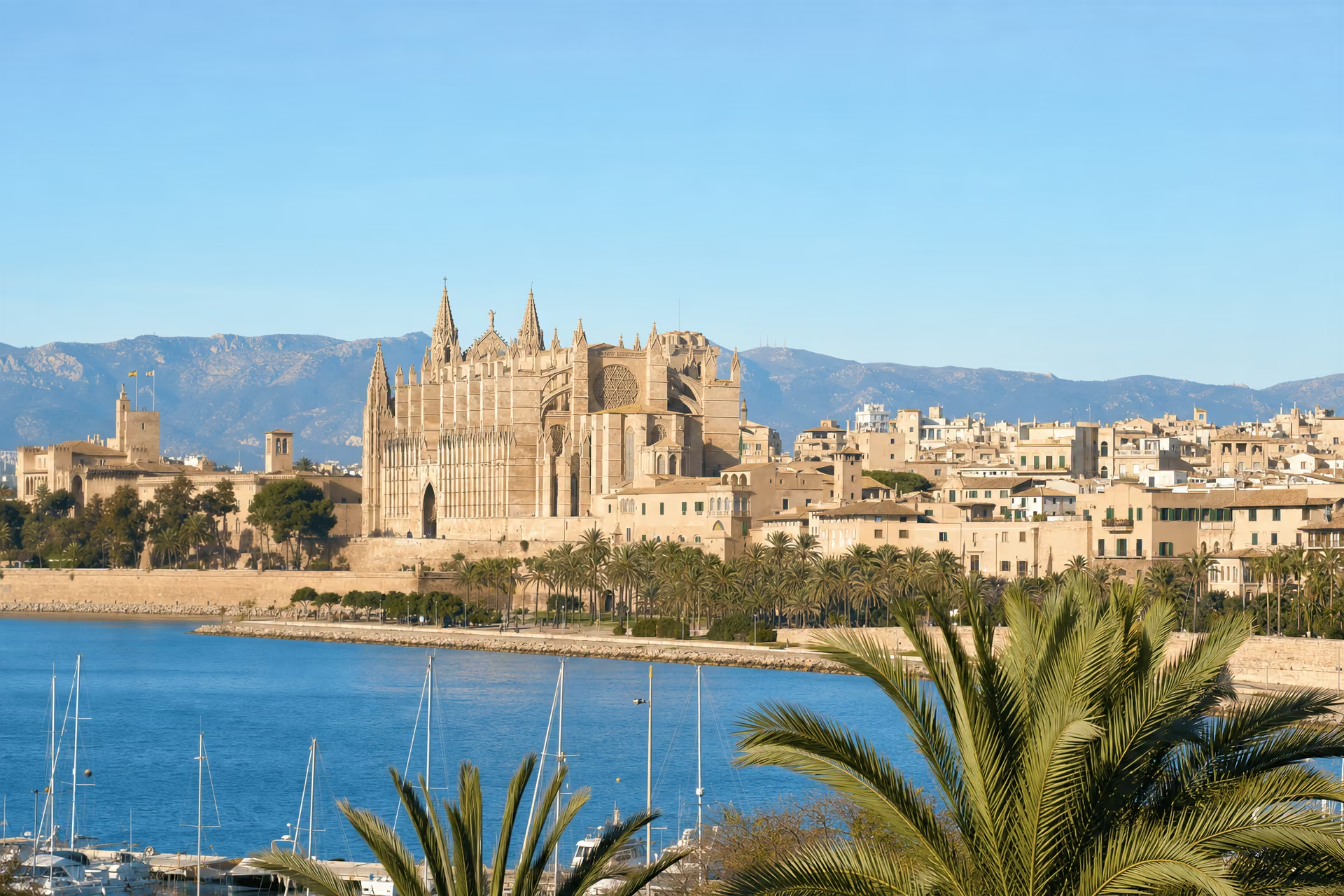
Mallorca (often spelled Majorca in English) is the largest of the Balearic Islands (Islas Baleares), an autonomous community of Spain in the western Mediterranean. Cannabis on the island is therefore governed by Spanish national law, layered with regional tolerance and, crucially, local police enforcement. The result is the famous Spanish "grey area" that confuses tourists every single summer season.
Here is the reality, stripped of myth:
- Private personal use is decriminalised. Consuming or possessing a small, personal quantity of cannabis inside a private home, a private villa, or a private members' association is not a criminal offence in Spain.
- Public use is prohibited and fined. Smoking a joint on the beach, in a park, on the street, in a parked car, or outside a nightclub is an administrative violation under the Ley Orgánica 4/2015 (the Ley de Seguridad Ciudadana, nicknamed the "Ley Mordaza" or "Gag Law"), with fines starting around €601.
- Buying and selling are illegal. Street dealing, trafficking, and commercial sale remain criminal offences under Article 368 of the Spanish Penal Code. There are no legal dispensaries and no Amsterdam-style coffeeshops anywhere in Spain.
- Home growing for personal use is tolerated — but only if the plants are not visible from any public space and the harvest is strictly for self-consumption.
- Cannabis social clubs occupy the grey zone. They are private, non-profit asociaciones cannábicas that exist on the strength of the right to private consumption — broadly tolerated across the Balearics, but never formally authorised by national law.
So: weed is neither fully legal nor strictly illegal on Mallorca. It is decriminalised in private and penalised in public — and internalising that single sentence is the most valuable thing this guide can give you.
Mallorca in one line:Private and discreet=tolerated. Public, commercial, or visible=fined or prosecuted.
2. Decriminalisation vs. Legalisation — The Distinction That Decides Everything
Spain's entire cannabis framework rests on one idea: decriminalisation without legalisation. Almost every tourist mistake — and a fair amount of online misinformation — flows from missing this difference. Understand it once and the rest of the law becomes intuitive.
Two words people constantly confuse
- Legalisation (as in Canada, Uruguay, Malta, Germany's adult-use framework, and several US states) means the state actively regulates and licenses production, distribution and sale. You get licensed shops, lab-tested products, tax stamps, branded packaging, and a legal supply chain from seed to sale.
- Decriminalisation (Spain) means a specific act is no longer treated as a crime, but it remains prohibited and can be punished administratively (a fine) rather than criminally (a court conviction, criminal record, or prison).
Spain decriminalised private cannabis consumption back in 1974, and the country's Constitutional Court has long defended a sphere of personal privacy — what a consenting adult does inside their own home is largely beyond the reach of criminal law. But Spain never built a legal market. There is no licensing regime for recreational cannabis, no legal retailer, no tax framework, no legal wholesale.
Why both "it's decriminalised" and "you can't legally buy it" are true
This is the paradox at the heart of Spanish cannabis. The plant can be legally consumed in private, yet there is no legal channel to purchase it. Decriminalised demand met by a prohibited supply — that exact gap is what the cannabis social club model was invented to bridge (more in Part II).
According to the European Union Drugs Agency (EUDA) — the EU body formerly known as the EMCDDA — Spain is one of the bloc's most permissive countries on personal use. Spain "does not formally penalise cultivation for personal use in places not visible to the public, or personal possession and use in private." Possession is penalised mainly "when the offence is committed in a public place." That single sentence from the EU's own drug agency is the cleanest statement of Spanish cannabis law you will find.
The layers of Spanish law that apply
- The Penal Code (Código Penal), Article 368 — criminalises trafficking, sale, cultivation for distribution, and supply. This is the serious, criminal tier.
- The Citizens' Security Law (Ley Orgánica 4/2015) — handles public possession and consumption as administrative offences (fines, not criminal records).
- Constitutional and Supreme Court case law — has carved out the private consumption and shared consumption doctrines that protect personal and collective private use within strict limits.
Key takeaway: In Spain, where and how you act matters more than the act itself. Private, personal, discreet, non-commercial → tolerated. Public, commercial, organised, visible → punished.
3. Public vs. Private: The Line That Defines Your Risk
If you remember only one section of this entire guide, make it this one. The boundary between "private" and "public" is the boundary between legal tolerance and a fine that can ruin your holiday budget.
What counts as "private" (tolerated)
- Your own home, owned apartment, or rented villa
- A private hotel room — with caveats: many hotels explicitly prohibit smoking, can charge cleaning penalties, and can involve the police; smoke detectors and shared balconies complicate things
- The interior of a genuine cannabis social club
- A private, walled garden or terrace not visible from the street or neighbouring properties
What counts as "public" (fined)
- Beaches — including the famous stretches of Playa de Palma, S'Arenal, Magaluf, Alcúdia and Cala Ratjada
- Streets, promenades (paseos), plazas and parks
- Bar terraces, restaurant terraces, and queues outside nightlife venues
- Cars parked on or driving on public roads (a car on a public road is treated as a public space)
- Hotel balconies, pools, and corridors visible or accessible to others
- Festivals and open-air events
The fines — under the Citizens' Security Law (Ley Orgánica 4/2015)
| Conduct (in public) | Legal classification | Typical penalty |
|---|---|---|
| Personal possession / consumption of cannabis in public | Serious administrative offence | €601 – €30,000 (a first minor offence commonly lands near €600) |
| Consumption near minors, schools or playgrounds | Aggravated administrative | Upper band of the range |
| Cultivation visible from a public space | Administrative / possibly criminal | Fine + confiscation, investigation if scale suggests supply |
| Possession of a larger quantity suggesting supply | Potential criminal (Penal Code Art. 368) | Prosecution, possible prison |
| Sale / supply / trafficking | Criminal offence | Prosecution, prison, criminal record |
Cannabis found in public is also confiscated on the spot. For tourists, the practical warning from local guides is blunt: police "regularly issue fines in summer, and tourists are often the first targets." A casual beach joint can become a very expensive souvenir — and unlike many minor fines, drug-related sanctions are taken seriously.
"Reasonable personal amount" — the unwritten threshold
Spain has no single nationwide statutory gram limit, but in private the consumption and possession of a reasonable personal amount (often discussed around up to ~100 grams in legal commentary, framed as a personal supply rather than a hard legal cap) is not criminalised. The larger the quantity — and the more it is divided, packaged, or accompanied by scales and cash — the more it looks like intent to supply, which flips the situation from administrative to criminal. Quantity, packaging and context are everything.
Practical rule of thumb for visitors: if you can be seen by the public, assume it's illegal. The law cares about visibility and commerce far more than about the plant itself.
4. What Happens If You Get Fined — The Process, Your Rights & Appeals
Most guides stop at "you'll be fined." But what actually happens if a police officer stops you with cannabis in public on Mallorca? Knowing the process reduces panic and helps you avoid making a minor administrative issue worse.
The typical sequence
- The stop. A Policía Nacional, Policía Local, or Guardia Civil officer observes or suspects consumption/possession in public.
- Confiscation. The cannabis (and any paraphernalia) is seized. You will not get it back.
- Identification. You'll be asked for ID — a passport for tourists. Carry it; failing to identify yourself can escalate matters.
- The denuncia (citation). The officer issues an administrative complaint under the Citizens' Security Law. This is not a criminal arrest for a small personal amount — it's an administrative sanction, similar in nature (though not amount) to a serious traffic fine.
- The proposed fine. A penalty is proposed, typically starting around €601.
Your rights and realistic options
- It is administrative, not criminal (for small personal amounts) — meaning no criminal record for a simple public-possession sanction, though it is still a formal sanction.
- You can pay early — Spanish administrative fines often allow a prompt-payment discount (commonly around 50%) if paid within a short window without contesting.
- You can appeal — you have the right to file alegaciones (written allegations) contesting the denuncia within the stated deadline, and ultimately to challenge it before the administrative courts. A local lawyer (abogado) experienced in sanciones administrativas can advise whether an appeal is worthwhile.
- Tourists are not exempt. Being a visitor doesn't make the fine disappear; unpaid Spanish administrative fines can be pursued and can complicate future dealings with Spanish authorities.
What turns a fine into something worse
- Quantity and packaging suggesting supply → criminal investigation.
- Consumption near minors → aggravated penalty.
- Resisting, abusing, or failing to identify to officers → separate, additional offences.
- Driving afterwards → a completely separate and serious matter (see Section 6).
Do not attempt to bribe an officer, run, or argue aggressively — all of these convert a manageable administrative fine into a genuine criminal problem. Stay calm, comply, identify yourself, and seek legal advice afterwards if you intend to contest.
5. Growing Cannabis at Home in Spain (Autocultivo)
Home cultivation — autocultivo — is one of the most misunderstood corners of Spanish cannabis law, and it matters for residents and long-stay visitors on Mallorca.
The core principle
Growing a small number of plants at home for your own personal consumption is treated as personal use and is not a criminal offence — provided two conditions are met:
- The plants must not be visible from any public space. This is non-negotiable. The "Gag Law" is explicit that grows "can't be visible from the street." A balcony plant in plain view of the pavement, or a garden visible to neighbours and passers-by, can trigger an administrative sanction — and undermines the "private use" defence.
- The harvest must be strictly for self-consumption. No selling, no sharing in a way that looks like distribution, no supplying others.
How many plants?
Here Spanish law is famously vague. There is no precise nationwide legal number. Legal commentary and practice suggest:
- A few plants (often discussed as around 2–4) for personal consumption is generally treated as personal use.
- Some autonomous communities and courts have referenced small numbers as reasonable, but these are guidelines, not a clear statutory cap.
- Scale is the red flag. Cultivation of a large amount — commonly cited around 20+ plants — with any evidence of distribution intent (packaging, scales, cash, customer lists) triggers a criminal investigation for cultivation with intent to traffic under the Penal Code.
Practical autocultivo rules
- Grow indoors or in a fully screened private space out of public sight.
- Keep numbers modest and proportionate to genuine personal use.
- Never advertise, sell, or gift in a way that resembles supply.
- Be aware of rental agreements and community-of-owners rules that may prohibit cultivation regardless of national law.
- Seeds and growing equipment are widely sold in Spain (grow shops are legal), but growing is the regulated act.
Bottom line: A discreet, modest personal grow that nobody outside your home can see sits on the tolerated side of the line. Visibility or scale pushes it toward the prohibited side.
6. Cannabis and Driving in Spain — The DGT Rules
This is the section that catches the most people off guard, and it is where Spain is at its strictest. If there is a true "zero-tolerance" zone in Spanish cannabis law, it is behind the wheel.
Zero tolerance, not "impairment"
Spain operates a zero-tolerance policy for illegal drugs in drivers. Unlike alcohol, where there is a legal blood-alcohol limit, for cannabis the mere presence of THC in your system is enough to be sanctioned — regardless of whether you are actually impaired and regardless of how much is detected.
How testing works
- The Guardia Civil de Tráfico (and sometimes the Policía Nacional) run roadside checkpoints with saliva (oral fluid) tests.
- A positive saliva test detects cannabis, cocaine, amphetamines, opiates and more.
- A positive result can be confirmed with further saliva, blood or urine testing, though the saliva test alone may be used to set the penalty.
The penalties
- €1,000 fine for testing positive for THC at the wheel.
- 6 points removed from your driving licence.
- Repeat offences: higher fines, longer licence suspensions, and potential imprisonment.
- If impairment, an accident, or injury is involved, the offence can escalate to a criminal matter — potentially 3–6 months in prison and driving disqualification of 1–4 years.
The detection-window trap
This is the part visitors rarely understand: THC lingers far longer than the "high."
- Occasional users: THC can be detected roughly 24–48 hours after consumption.
- Regular users: detectable for days, in some cases 30+ days.
That means you can be completely sober, feel perfectly fine, and still fail a roadside test for cannabis consumed days earlier — and still receive the €1,000 fine and 6 points. The test detects presence, not impairment.
Unambiguous advice: if you have consumed cannabis recently — even days ago — do not drive in Spain. There is no safe margin, no legal threshold, and the consequences are severe. Use taxis, transfers, or public transport.
7. Airports, Ferries & Travelling With Cannabis (Mallorca Is an Island)
Because Mallorca is an island, almost everyone arrives and leaves through Palma de Mallorca Airport (PMI) — Spain's third-busiest airport — or by ferry from the mainland and the other Balearic Islands. That makes the travel rules especially important, and especially easy to get catastrophically wrong.
The one rule that overrides everything
Never travel with cannabis. Moving cannabis across any border — and even between regions by air or sea — is drug trafficking, a serious criminal offence. The relaxed private-use tolerance you read about in Sections 1–3 evaporates completely at a transport hub.
Specifics that catch travellers out
- Leaving Mallorca by air: carrying cannabis through PMI — even a small amount, even in checked luggage — risks criminal charges. Airport security and the Guardia Civil are present and attentive.
- Flying home (international): taking cannabis out of Spain into another country compounds the offence under both countries' laws. Penalties abroad can be far harsher than Spain's.
- Ferries and inter-island travel: ferry terminals and ports are policed; transporting cannabis by sea is trafficking just as surely as by air.
- CBD products: even legal-in-Spain CBD can be problematic to travel with internationally, because THC thresholds and legality differ by country. What's a legal cosmetic in Spain can be illegal elsewhere.
- Medical cannabis: the new Spanish medical framework (Section 20) does not create a tourist import/export right; carrying medical cannabis across borders is governed by strict international rules and prescriptions.
The mindset to adopt
Treat cannabis as something that must stay exactly where it was lawfully consumed — inside a private space on Mallorca. The moment it moves toward an airport, a port, or a border, it becomes a criminal-law problem, not an administrative one.
Leave it behind. Whatever you do, do not let a relaxed holiday end with a trafficking charge at PMI. Nothing is worth that.
8. A Deep History of Cannabis in Spain and the Balearics
To understand why Mallorca's cannabis landscape looks the way it does, you have to understand how Spain arrived here. This is not a country that legalised cannabis by parliamentary decision — it is a country where decades of activism, court battles and civil disobedience carved out a tolerated space the law never explicitly granted.
Ancient and maritime roots
Cannabis, in the form of hemp (cáñamo), has been cultivated in the Iberian Peninsula for centuries — for rope, sail-cloth, paper and textile. Spain's seafaring empire ran on hemp rigging. The country's geography also made it Europe's great cannabis gateway: its proximity to Morocco, one of the world's largest historical producers of hashish (costo in Spanish slang), turned southern Spain into a centuries-old conduit for hash entering the continent. Cannabis is, in a real sense, woven into Spanish maritime and cultural history.
1974 — the quiet decriminalisation of private use
Spain stopped treating private personal consumption as a crime in 1974, establishing the foundational principle that what an adult does privately with cannabis is not the state's criminal business. This single idea — never the result of a grand legalisation law — is the bedrock everything else is built on.
1993 — ARSEC and the birth of cannabis activism
The modern cannabis movement was born in 1993 with the founding of ARSEC (Asociación Ramón Santos de Estudios sobre el Cannabis) in Barcelona — Spain's first cannabis association. ARSEC's strategy was brilliantly legalistic: rather than simply break the law, they wrote to the anti-drug public prosecutor asking whether growing cannabis collectively for a group of adult consumers would be a crime. The prosecutor replied that, in principle, it would not be. Emboldened, ARSEC organised a cultivation experiment intended to supply around 100 people.
The crop was confiscated. A provincial court acquitted those involved — but on appeal the Supreme Court ruled that, even though ARSEC had no intent to traffic, cultivation of cannabis was "dangerous per se" and therefore punishable. It was a setback, but it had established the central question that would define the next 30 years: if private consumption is legal, can people legally grow together to supply it?
1997 — Kalamudia and civil disobedience in the Basque Country
In 1997, the Basque association Kalamudia escalated the strategy into open civil disobedience. They publicly announced and planted a field of around 600 plants for some 300 members in Vizcaya — deliberately visible, deliberately provocative, designed to make adult cannabis use visible and force the courts to rule. When the crop was harvested in September 1997, the judge ruled there was no crime, and the anti-drug prosecutor did not appeal. It was a watershed: a concrete, public demonstration that collective cultivation for closed groups could survive legal scrutiny.
2001–2010s — the Cannabis Social Club model spreads
Out of this activism grew the Cannabis Social Club template. Pioneering associations — most famously Pannagh in Bilbao (registered as a non-profit in 2003 and led by activist Martín Barriuso, also president of the Spanish Federation of Cannabis Associations, the FAC) — refined the model: a closed, non-profit association whose members collectively fund and share a cannabis supply for their own private use. Clubs multiplied across Catalonia, the Basque Country, and increasingly the Balearic Islands, each operating under whatever level of local tolerance prevailed.
2015 — the Supreme Court draws the boundaries
The model's rapid growth provoked a reckoning. In 2015, the Supreme Court issued a trio of rulings — the Pannagh case being the most cited — that defined exactly how far the club model could legally stretch. The short version: small, closed, genuinely private associations might be tolerable, but large, openly recruiting, heavily stocked clubs were trafficking (full detail in Section 10).
2017 — Catalonia tries to regulate, and the Constitutional Court says no
Catalonia attempted to formalise clubs with a regional law in 2017, creating registration, hygiene and operational rules. The Constitutional Court struck down the key provisions, ruling that only the national parliament — not a region — has the authority to regulate this area of drug law. The message was unambiguous: meaningful reform must come from Madrid, and Madrid has not delivered it.
2025 — medical cannabis finally arrives
After years of delay, Spain approved Royal Decree 903/2025 in October 2025, creating a tightly controlled medical cannabis pathway (Section 20). It is the most significant national cannabis policy change in years — though it deliberately stays separate from the recreational and club spheres.
The Balearic result
This long, contested history produced a distinctly tolerant Balearic culture. Cannabis social clubs became relatively widespread across Mallorca, Ibiza and beyond — generally tolerated by local authorities as long as they follow the rules: private, non-commercial, members-only, and emphatically not marketed to tourists. The tolerance is real, but it is conditional and revocable, and the islands' authorities have repeatedly shown they will act against clubs that cross the line.
9. What Exactly Is a Cannabis Social Club (CSC)?
A Cannabis Social Club — club social de cannabis, asociación cannábica, or simply CSC — is a private, non-profit association of adult cannabis consumers who collectively organise the cultivation and shared distribution of cannabis strictly among their own registered members. It is the central institution of Spanish cannabis culture and, in practice, the primary lawful-grey pathway through which people access cannabis in 2026.
The defining features of a genuine, compliant CSC
- Non-profit. A CSC is not a business. It does not exist to generate profit; members' contributions cover the real costs of cultivation, premises, security and administration.
- Closed and members-only. It is not open to the public. There is no shop window, no street menu, no walk-in retail. Access requires formal membership.
- Collective, not commercial. Members pool resources to fund a shared cultivation. What a member receives is framed as their share of a collective supply, not a retail "sale" to a customer.
- Invitation-based admission. Membership is obtained through invitation or referral from an existing member or partner organisation, plus a valid ID — never by public recruitment.
- Private premises. Clubs occupy discreet, often residential or commercial-but-unmarked buildings, identified only by a buzzer or small logo. No neon, no touts, no street advertising.
- Consumption on-site or at home. Members may consume inside the club (which functions as a private lounge) or in their own private residence — never in public.
- A members' register and statutes. A real association has formal statutes, a register of members, and governance (a board, assemblies). This paperwork is part of what makes it an association rather than a front for dealing.
A CSC is NOT a coffeeshop
This distinction is the single costliest tourist misunderstanding. A Dutch coffeeshop is a tolerated retail outlet open to any adult who walks in. A Spanish CSC is a private members' association that, by legal necessity, must avoid any appearance of public sale or advertising. One is a (regulated) shop; the other is a (grey-area) private club. Treating a Spanish club like a coffeeshop — expecting to walk in off the strip and buy — is exactly the behaviour that gets clubs raided and closed.
Why the rules are so strict
The entire legal survival of the club model depends on staying private and non-commercial. The moment a club behaves like a shop — advertising to tourists, admitting non-members, selling to strangers, handing flyers out on the beach — it loses the protection of the private-consumption doctrine and becomes, in the eyes of the law, drug trafficking under Article 368. The discretion you encounter at a real club is not snobbery or theatre; it is legal self-preservation.
10. The Legal Foundation: The "Shared Consumption" Doctrine & the 2015 Rulings
Cannabis social clubs in Spain stand on one slender but real legal pillar: the doctrine of shared consumption (doctrina del consumo compartido), developed by the Spanish Supreme Court (Tribunal Supremo). Understanding it explains every rule a good club enforces.
The principle
Spanish courts recognised that several adults consuming cannabis together, in a private and non-commercial setting, for immediate personal use, is not inherently criminal trafficking. Sharing a private supply among a closed circle of adult consumers is conceptually different from selling to the public. That principle is what allowed asociaciones cannábicas to argue they were organised, collective expressions of a right that already existed for individuals.
The hard edges — the limits the doctrine imposes
The doctrine has never been a blank cheque. The courts attached strict conditions. Shared consumption is protected only when it involves:
- a small group of consumers,
- in a closed, private place,
- with small quantities,
- intended for immediate consumption,
- among people whose cannabis use is already established (not introducing new users),
- and without any profit motive.
The further a club drifts from these conditions — more members, open recruitment, large stockpiles, profit — the more it looks like distribution rather than shared consumption.
The landmark: the Pannagh ruling (STS 788/2015, 9 December 2015)
Pannagh was a pioneering, properly registered non-profit cannabis association in Bilbao, led by Martín Barriuso. After an initial acquittal by the Provincial Court of Bizkaia, the Public Prosecutor appealed, and the Supreme Court (Judgment 788/2015 of 9 December 2015) partially upheld the appeal and convicted four members.
The Court's reasoning set the boundaries that still govern every Spanish club today. It held that the shared-consumption doctrine could not stretch to an organisation with:
- more than 300 members,
- open admission to new members,
- and stocks exceeding 100 kg every six months.
Such a structure, the Court found, was incapable of controlling the risk that cannabis would diffuse to people outside the circle of members — and therefore amounted to drug trafficking, not protected shared consumption.
Sentences included 1 year and 8 months in prison plus a €250,000 fine for the leadership, and shorter terms for other members. Two further Supreme Court judgments in 2015 reinforced the same conclusion: organised, institutionalised, persistent cultivation and distribution within an association open to new members is trafficking. The EUDA summarises it cleanly — in 2015 the Spanish Supreme Court concluded that such organised club activity "is considered to be drug trafficking."
2017 — the Constitutional Court closes the regional route
When Catalonia passed a law to regulate clubs in 2017, the Constitutional Court annulled the core provisions, holding that drug policy is a national competence. Regions can tolerate, inspect for public-health and licensing matters at the margins, and exercise local discretion — but they cannot legalise or formally authorise cannabis clubs. Only the national parliament can, and it hasn't.
What this means for you on Mallorca
Every cautious rule a reputable Balearic club enforces — small, closed membership; invitation-only admission; ID checks; no advertising; no tourists-as-walk-in-customers; modest quantities; no resale — is a direct, deliberate response to the Pannagh limits. Clubs that ignore these limits don't just risk closure; their organisers risk prison. That is why the good clubs are so careful, and why the careless "tourist clubs" are precisely the ones that get raided.
The doctrine in one sentence:Small, closed, private, non-profit, immediate shared use is tolerated; large, open, stockpiled, profit-seeking distribution is trafficking.
11. How a Cannabis Club Actually Operates
Beyond the law, what does a genuine asociación cannábica actually do? Understanding the mechanics demystifies the model and helps you tell a legitimate association from a front.
The collective cultivation cycle
A compliant club works on a closed-loop, members-fund-their-own-supply basis:
- Members register and declare their estimated personal consumption needs.
- The association arranges cultivation — its own grow or a contracted cultivation — sized to the aggregate declared needs of its members, not to an open market.
- Costs are pooled. Members' contributions cover cultivation, premises, utilities, security, testing and administration.
- Members collect their allocated share, framed as recovering their portion of a collective harvest they funded — not a retail purchase.
Quotas and limits
Reputable clubs impose personal monthly limits on how much a member can collect — partly to respect the consumo compartido requirement of "small quantities for personal use," and partly to prevent diversion to the black market (the exact risk the Supreme Court warned about). A club that lets anyone collect unlimited amounts is behaving like a wholesaler, not an association.
Transparency, testing and quality
Because the model is collective and non-commercial, the better associations emphasise member welfare: lab-style testing of cannabinoid content, harm-reduction information, clean and safe consumption lounges, and transparency about what members are consuming. This consumer-protection angle is one of the model's genuine public-health arguments — a closed, accountable supply versus an unregulated street market.
Governance
A real association has statutes, a board, member assemblies, and proper bookkeeping. It is a legal entity registered as a non-profit. This governance layer is part of what distinguishes an association acting in good faith from a commercial dealing operation merely calling itself a club.
The amenities members describe
Inside, clubs typically function as private social lounges — comfortable seating, a relaxed atmosphere, sometimes refreshments, games, music or events — emphasising the "social" in "social club." The point is a private, safe, communal space for adult members, not a transaction counter.
12. Can Tourists Join a Cannabis Club on Mallorca?
This is the second-most-searched cannabis question on the island after "is weed legal on Mallorca?" — and the honest answer is: sometimes, conditionally, and never the way the touts on the strip promise.
Here is the nuanced truth, with no marketing spin:
- There is no Spanish law banning foreigners from membership. As a matter of national law, "it is legal for you to join a cannabis club" as a non-resident, and "membership is allowed to anyone, including tourists." Nationality is not the legal barrier.
- But each club sets its own admission rules. Many Balearic clubs require Spanish residency, a local address, or a resident's ID, and tourists are frequently excluded — not out of unfriendliness, but because tourist-facing clubs are the ones that get raided and shut down. Caution is survival.
- A genuine club can never legally solicit you in public. Because clubs must stay private and non-commercial, "they can't openly advertise to tourists or act like shops." Any "club" with a street promoter waving a leaflet at the beach is, by definition, breaking the very rules that keep clubs legal — a giant red flag (see Section 16).
- Membership is by invitation or referral. The standard, lawful route is an invitation from an existing member or a partner organisation, followed by registration with a valid ID and, often, a short waiting period.
The tourist paradox
The more aggressively a "club" courts tourists, the less likely it is to be a real, compliant, safe association. Legitimate clubs are discreet by legal necessity. If something feels like a sales funnel aimed at holidaymakers — QR codes on the strip, "instant membership," promoters outside bars — treat it with extreme caution.
The responsible visitor's position
For visitors, the responsible stance is simple and keeps you safe: understand the law, never consume in public, never buy from street dealers, and recognise that lawful access — if available to you at all — is private, ID-gated, invitation-based, and explicitly not advertised. A real association will tell you the same thing this guide does.
13. How Membership Legally Works — Step by Step
For lawful adult members, the membership process of a compliant asociación cannábica generally follows a recognisable pattern. If a "club" skips these steps, that itself is a warning sign.
- Invitation or referral. You are introduced by an existing member or a partner organisation. Clubs cannot legally recruit the general public, so a referral is the normal, lawful gateway.
- Age verification. Spanish law sets the legal-adult threshold at 18, but most clubs require 21+. Minors are never admitted under any circumstances.
- Valid ID at registration. Every new member must present a valid government ID (passport for visitors). The club records you in its members' register.
- Signing the statutes & paying the membership fee. You agree to the association's rules and pay an annual membership contribution (commonly €15–€50 depending on the club). This is a membership fee that funds the non-profit — it is not a purchase of cannabis.
- Cooling-off / waiting period. Many clubs apply a waiting period before a new member can collect any share, reinforcing the non-commercial, non-walk-in character the law requires.
- Membership card & access. Approved members receive a card or credential granting entry to the private premises.
The standing rules every member accepts
- No resale of cannabis outside the club — ever.
- No minors inside or involved.
- No photos or videos of other members — member privacy is sacred.
- Quiet, respectful behaviour — clubs sit among neighbours and depend entirely on local goodwill.
- Consumption only inside the club or in your own private residence — never in public.
- No bringing guests who are not members.
Every one of these rules maps directly back to the Supreme Court's Pannagh limits (Section 10). They are not bureaucracy for its own sake — they are what keep the association on the lawful side of the line.
14. The Mallorca Cannabis Scene, Region by Region
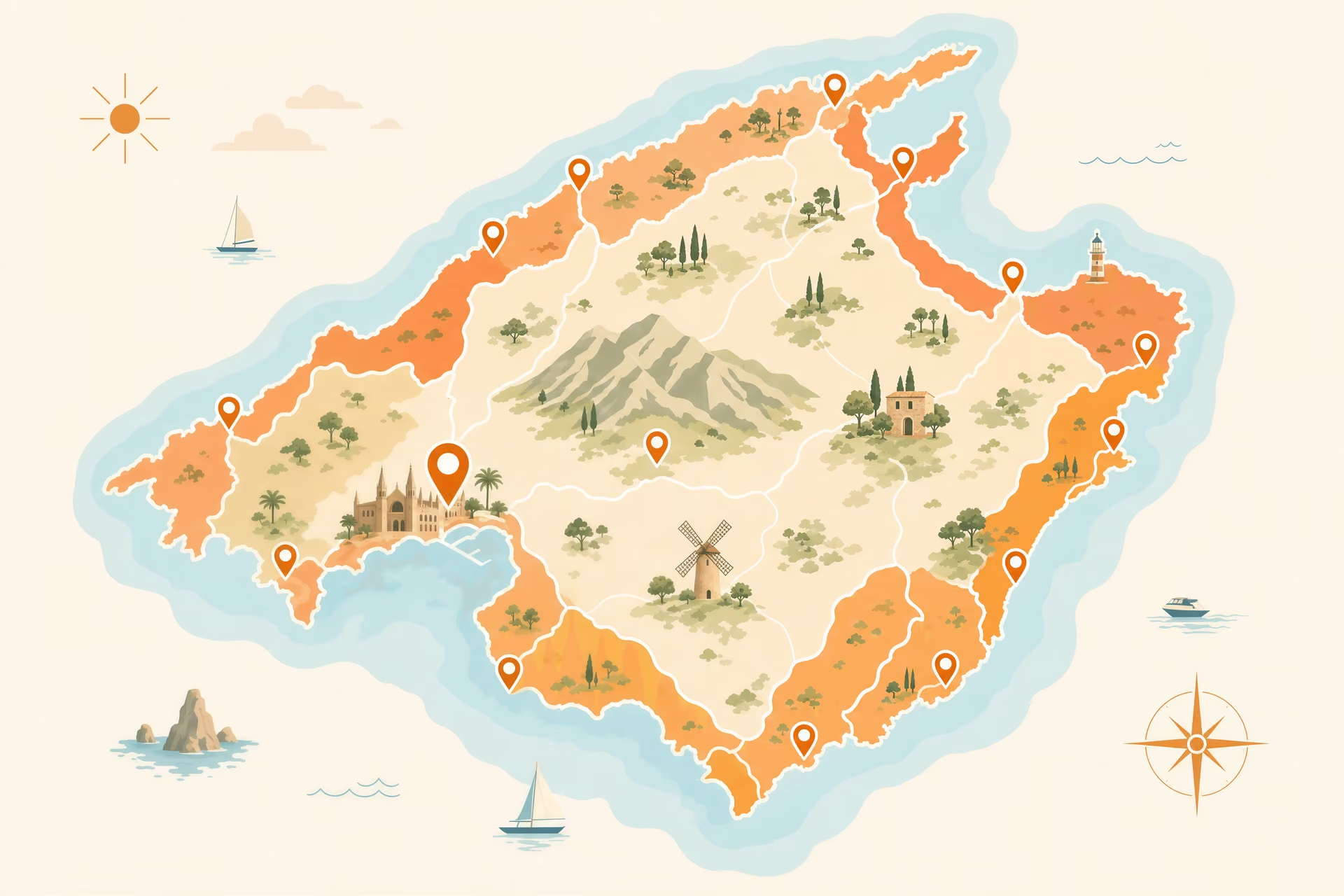
Mallorca's cannabis culture is real, long-established and — within the private sphere — comparatively relaxed, but it is also geographically uneven and under active scrutiny. Here's how the landscape varies across the island, purely as orientation (this is not a directory and not an endorsement of any venue).
Palma de Mallorca
The island capital is the centre of gravity for the asociación cannábica community. The cannabis culture here is the most developed, and associations — where they exist — are discreet, residential and members-only. Palma is also where enforcement is most organised, so the contrast between genuine, careful associations and risky pop-ups is starkest.
Playa de Palma & S'Arenal
The heart of mass tourism — and therefore the heart of both street-level activity and police attention. This stretch is where tourist-targeted scams and fake "clubs" concentrate. It was here that National Police raided a meeting disguised as a club, making five arrests on suspicion of organised cannabis trafficking. The lesson writes itself: the most touristy zones are the riskiest, not the safest.
Magaluf & Palmanova (Calvià)
Party-tourism hotspots where street dealers and dubious offers target young holidaymakers. High visibility, high enforcement, high scam risk. Public consumption fines are actively issued here in season.
Alcúdia & the North
Family-oriented resort areas in the north. Cannabis culture is quieter and more residential; public consumption is just as illegal as everywhere else, and tourist-facing operations are rare and risky.
Cala Ratjada & the East
A traditionally German-favoured holiday area. As with the rest of the island, anything aimed at tourists deserves scepticism, and beaches and promenades are public spaces where fines apply.
Manacor, Inca & the interior
Mallorca's working towns away from the coast. Cannabis culture here is local and low-profile, oriented to residents rather than visitors.
Sóller, Pollença, Andratx, Santanyí & the scenic towns
Smaller, picturesque municipalities where any cannabis activity is very discreet and community-based. There is no tourist cannabis "scene" to speak of — and public consumption in these postcard towns is as fined as anywhere.
Santa Ponsa, Magaluf's neighbours & the southwest (Calvià)
The southwest coast around Santa Ponsa, Palmanova, Portals Nous and Peguera is dense package-holiday and nightlife territory. As with Magaluf, the combination of young tourists, alcohol and nightlife makes it a focal point for street offers and scams, and a place where public-consumption fines are routinely issued. Discretion and scepticism are doubly important here.
Cala d'Or, Cala Millor, Sa Coma & the southeast resorts
The southeastern resort belt is heavily holiday-oriented. Cannabis culture is not visible or tourist-facing in any legitimate sense; anything presented to visitors as easy access should be treated as a red flag. The beaches and marinas are public spaces subject to the same fines as everywhere on the island.
Capdepera, Felanitx, Llucmajor & the rural municipalities
Away from the resort strips, Mallorca's rural municipalities are quiet, residential and local. Whatever cannabis culture exists is community-based, low-profile, and oriented to residents — not a scene a visitor will (or should) stumble into.
Why enforcement concentrates in the tourist south
There's a clear geography to risk on the island. The southern and southwestern tourist corridor — Palma's beaches, Playa de Palma, S'Arenal, Magaluf, Santa Ponsa — concentrates the scams, the street dealing, and the police attention, precisely because that's where the tourist demand (and the operators who prey on it) cluster. The interior and the quieter north and east see far less tourist-facing activity and far less of the associated risk. The single best predictor of cannabis trouble on Mallorca is proximity to mass-tourism nightlife — which is exactly where visitors are most tempted and most exposed.
The Balearic equilibrium
Across all regions, the deal is the same: private, compliant associations are broadly tolerated; public consumption and tourist-targeted pseudo-clubs are not. Stay on the right side of that line and the island is calm. Cross it — especially in the tourist-saturated south — and you meet the fine schedule from Section 3 or worse.
15. How People Legally Access Cannabis on Mallorca
Let's address the question everyone actually has, honestly and within the law. Since there are no shops and no coffeeshops in Spain, how do adults on Mallorca lawfully obtain cannabis at all? There are, in practice, three lawful-grey routes — and one route (the street) that is simply illegal and should be avoided entirely.
Route 1 — Private home cultivation (autocultivo)
A resident or long-stay adult can grow a small number of plants for personal consumption, provided the grow is private, out of public view, and modest in scale (see Section 5). This is the most self-contained lawful route: you consume what you privately grow, in private. No transaction, no supplier, no public exposure.
Route 2 — Cannabis social club membership
The principal route most people use is membership of a cannabis social club. As a member of a genuine, compliant association, you can obtain your allocated personal share of a collective, member-funded supply, to consume inside the club's private lounge or in your own home. This is a membership-and-share model, not a retail purchase — and it is restricted to registered adult members admitted by invitation with valid ID. Whether a given club admits non-residents is up to that club, and many do not.
Route 3 — Private sharing among adults
Under the consumo compartido doctrine (Section 10), adults can share their own private cannabis among a small, closed group in a private setting for immediate consumption, without that being trafficking — provided there is no profit motive and it stays genuinely private and small-scale.
The route to avoid completely — the street
Street dealers are illegal, unsafe, and a magnet for scams. Buying from a dealer on the strip or beach is a criminal-adjacent risk (possession in public is fined; the transaction itself feeds trafficking), the product is frequently adulterated, mouldy, or fake, and tourists are routinely ripped off or set up. There is no scenario in which the street is the smart choice.
The honest summary
So, can you access cannabis legally on Mallorca? If you are a lawful adult, yes — through private cultivation, club membership, or private sharing — but always privately, never commercially in public, and never via the street. The legal system rewards discretion and punishes anything that looks like a public market.
Reminder: This is informational only. It is not an offer or an invitation to consume, and it does not direct you to any specific seller or club. Always verify the current law and a club's legitimacy before acting.
16. Scam Warnings, Red Flags & Staying Safe
Where there is demand, prohibition, and millions of tourists, there are scams. Protecting yourself starts with recognising the warning signs — because on Mallorca the scams are not rare edge-cases, they are an industry.
Common cannabis scams on Mallorca
- Street dealers targeting tourists with poor-quality, adulterated, or outright fake product — illegal to buy and risky to your health, your wallet, and your liberty.
- Fake "clubs" that aggressively recruit holidaymakers, charge inflated "membership," and may be fronts that attract police raids — exactly like the Playa de Palma raid that ended in five arrests.
- Messaging-app traps — "Telegram weed," "WhatsApp weed," "Signal weed" contacts and QR codes handed out on the strip, frequently scams, stings, or robbery setups.
- Touts and "guides" who promise to "get you in" to a club for a fee, or offer to escort you somewhere off the beaten path.
- Overpriced "membership" demanded in cash on the spot with no real association behind it.
Red flags of an illegitimate operation
- Public advertising, flyers, neon, or street promoters — a real club legally cannot do any of this.
- Pressure to pay cash immediately, "today only," or urgency tactics.
- No proper membership process — no referral, no ID check, no statutes, no waiting period.
- Anyone offering to simply sell you cannabis as a one-off transaction, member or not.
- Locations that change or that you're led to by a stranger.
Staying safe and lawful
- Never buy from street dealers. It is illegal, unsafe, and a common scam.
- Never consume in public. Beaches, streets, terraces and cars all carry the €601+ fine risk.
- Be sceptical of anything aimed at tourists. Discretion is the hallmark of legitimacy; aggressive tourist marketing is the hallmark of a trap.
- Verify before you trust. A genuine association won't pressure you, won't advertise publicly, and won't rush you.
- Protect your health. Cannabis affects everyone differently; combining it with alcohol, intense sun, dehydration and unfamiliar surroundings amplifies risk. If you feel unwell, seek shade, water and, if needed, medical help — Spain's emergency number is 112.
Harm-reduction note: This guide does not encourage consumption. If you choose to use cannabis where it is lawful to do so, do it privately, moderately, never before driving, and never around minors. Your safety and the community's fragile legal tolerance both depend on it.
17. Cannabis Products & Strains Found in Spanish Clubs
For educational context, here is an overview of the types of cannabis products that exist within Spanish cannabis culture and the asociación cannábica world. This is informational — it is not a menu, a price list, or an offer.
Cannabis is also commonly known as marijuana, and the varieties found at the island's clubs span both indica and sativa types.
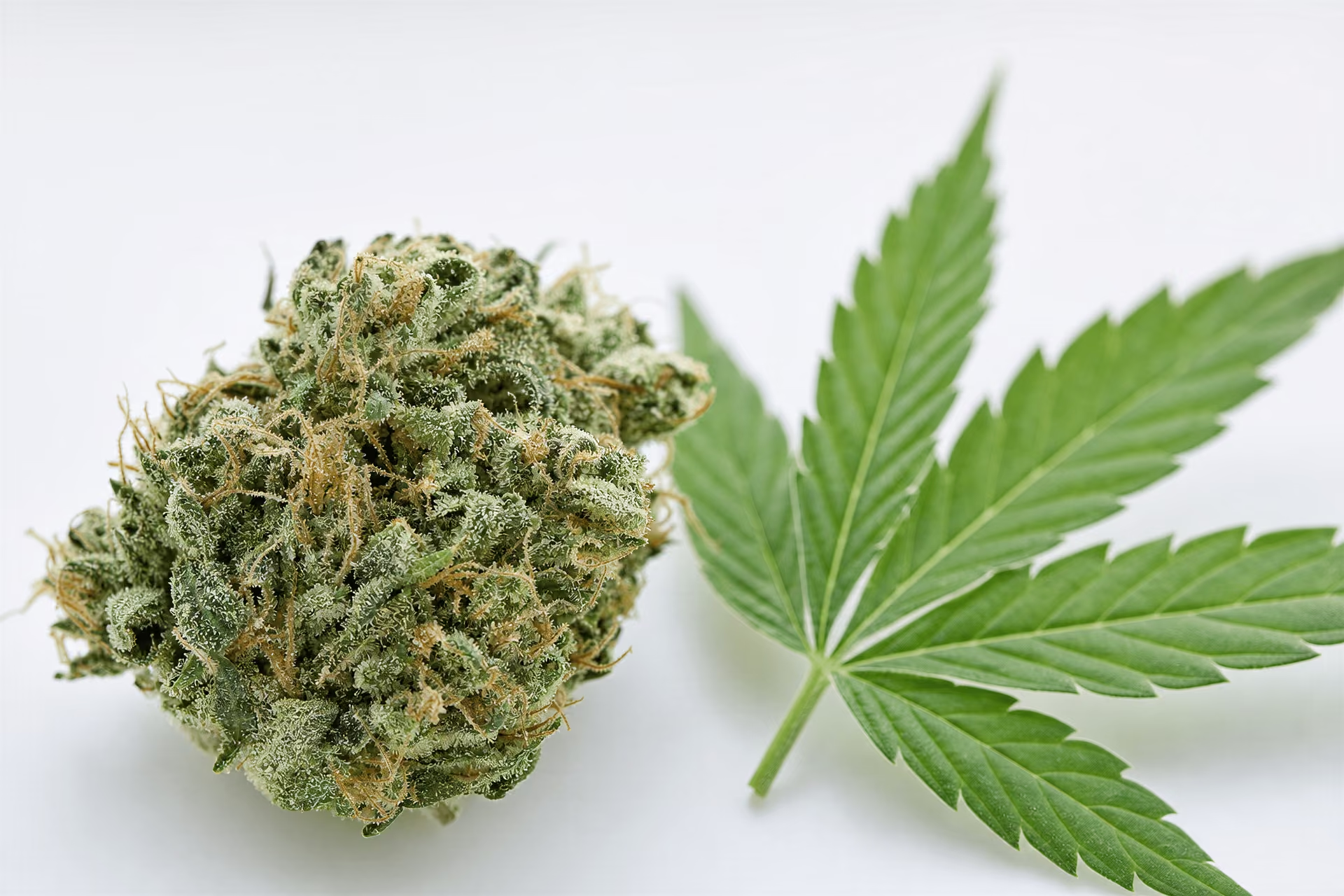
Flower (cogollos / buds)
The most familiar form: the dried flowers of the female cannabis plant. Spanish clubs and growers reference the global landscape of strains (variedades), broadly grouped as:
- Indica-leaning varieties, traditionally associated with heavier, more physically relaxing effects.
- Sativa-leaning varieties, traditionally associated with more cerebral, energetic effects.
- Hybrids, which blend characteristics — the overwhelming majority of modern cultivars. Modern cannabis breeding has produced a vast catalogue of named cultivars, and Spain — with its strong seed-bank industry (many world-famous cannabis genetics companies are Spanish) — is deeply embedded in global cannabis breeding culture.
Hashish (hachís / costo)
Spain's geographic and historical ties to Morocco make hashish central to its cannabis culture. Hash is the compressed resin (trichomes) of the plant, ranging from traditional imported Moroccan-style hash to artisanal domestic production. It remains one of the most culturally significant cannabis products in Spain.
Concentrates & extracts
More modern, higher-potency products — rosin, resin, and other extracts — concentrate cannabinoids and terpenes. These are far stronger than flower and demand much greater caution, particularly for inexperienced consumers.
Edibles & infusions
Cannabis-infused edibles (foods) and infusions deliver cannabinoids through digestion. The effects are delayed (often 30–120 minutes) and can be stronger and longer-lasting than expected, which is precisely why edibles cause the most accidental over-consumption. The cardinal rule is start low, go slow.
CBD products
Non-intoxicating CBD flower, oils and cosmetics occupy a separate, more openly available category (see Section 19).
Potency has risen dramatically over the past two decades. Modern flower and especially concentrates can be many times stronger than the cannabis of the 1990s — a key public-health consideration discussed next.
18. The Science: THC, CBD, Terpenes & Effects
A genuinely authoritative cannabis guide has to explain the plant itself. Here's the science, in plain language.
Cannabinoids — the active compounds
Cannabis produces a family of compounds called cannabinoids. The two most important are:
- THC (tetrahydrocannabinol) — the primary psychoactive (intoxicating) cannabinoid, responsible for the "high," and also the compound that triggers a positive roadside drug test (Section 6).
- CBD (cannabidiol) — non-intoxicating; it does not produce a high and is widely studied for potential calming and other properties. CBD is the basis of the legal "cannabis light" market (Section 19).
Other minor cannabinoids — CBG, CBN, THCV and more — contribute subtler effects and are an active area of research.
Terpenes — aroma and the "entourage effect"
Terpenes are the aromatic compounds that give different cannabis varieties their distinctive smells — citrus, pine, diesel, earth, berry. Beyond aroma, many researchers believe terpenes interact with cannabinoids to shape the overall experience, a hypothesised phenomenon called the "entourage effect."
How effects vary
The experience depends on the product's cannabinoid and terpene profile, the dose, the consumption method, and the individual — body chemistry, tolerance, mindset and setting all matter. Inhaled cannabis acts within minutes and fades within a few hours; edibles are delayed and longer-lasting. There is no single "cannabis effect" — it is a spectrum.
The health picture — an honest summary
- Short-term effects can include relaxation, altered perception, increased appetite, and impaired coordination, memory and reaction time.
- Risks include anxiety or panic (especially at high THC doses), impaired driving ability, and — particularly relevant with today's high-potency products — risks for adolescents, pregnant people, and those with a predisposition to certain mental-health conditions.
- Dependence is possible, particularly with heavy, frequent use.
- Public-health bodies such as the EUDA track these harms across Europe and consistently emphasise that higher-potency products carry higher risks.
This is not medical advice. Anyone with health concerns, existing conditions, or who is pregnant or breastfeeding should consult a qualified healthcare professional. Cannabis affects everyone differently.
19. CBD and "Cannabis Light" in Spain
CBD (cannabidiol) occupies its own, far more relaxed category — and it's the one corner of the "cannabis" world a visitor can engage with openly and lawfully on Mallorca.
What's legal and where you'll see it
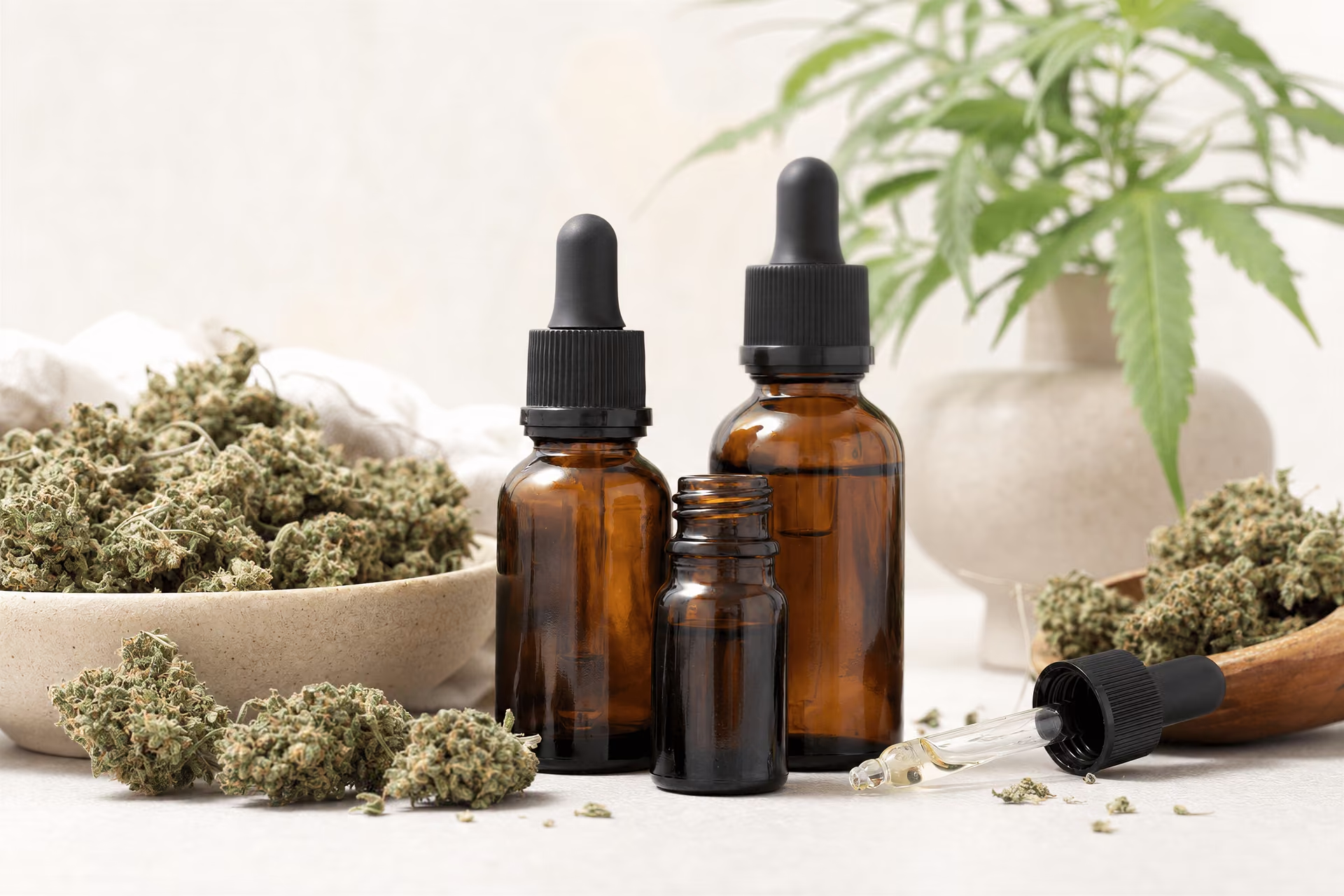
Across Spain and Mallorca you'll find CBD oils, flowers, cosmetics and topicals sold openly in dedicated shops, grow shops, and even some pharmacies and health stores. These products are derived from industrial hemp with only trace THC, in line with EU hemp rules.
The crucial dividing line — THC content
- Legal CBD/hemp products contain only trace THC (within EU industrial-hemp limits).
- Anything with meaningful THC is not a CBD product and falls under the recreational-cannabis rules described throughout this guide.
- CBD is not psychoactive — it won't get you high and is a different product class entirely.
The regulatory grey zone
There's an important nuance: in the EU and Spain, CBD intended for human ingestion faces tighter regulation (the "Novel Food" framework) than CBD sold as a cosmetic or topical. That's why much CBD in Spain is marketed as cosmetic, aromatherapy, or "collector" product rather than as a supplement to be eaten. Spanish and EU politicians have repeatedly discussed clearer regulation of "cannabis light" (low-THC, under ~1% THC), but a fully settled framework has been slow to arrive.
Practical buyer guidance
- Read the label — check the THC content and whether it's sold as cosmetic vs. ingestible.
- Buy from reputable retailers with transparent lab results.
- Remember the travel trap (Section 7) — legal-in-Spain CBD can be illegal in your home country, so never assume you can fly home with it.
20. Medical Cannabis in Spain — Royal Decree 903/2025
After years of political delay, Spain took a historic step on 7 October 2025, when the Council of Ministers approved Royal Decree 903/2025, creating a regulated framework for the medicinal use of cannabis. It is essential context for any serious cannabis-in-Spain discussion — but it is not a route to recreational or tourist access.
What the decree actually does
- Standardised "master formulas" only. It authorises standardised cannabis preparations (fórmulas magistrales) with preset THC/CBD concentrations. Critically, dried flower (raw plant material) is NOT authorised for medical use.
- AEMPS oversight. The Spanish Agency of Medicines and Medical Devices (AEMPS) maintains a public register of authorised preparations and enforces strict controls on THC/CBD content, production quality and traceability.
- Hospital-restricted prescribing. Only hospital-based specialists within the national health system (SNS) — such as oncologists, neurologists, and pain specialists — may prescribe. GPs and private-clinic doctors cannot.
- Hospital pharmacy dispensing. Preparation and dispensing are limited to authorised hospital pharmacy services, not regular pharmacies.
Timeline
The decree entered into force the day after its publication in the BOE (Official State Gazette). The AEMPS then has three months to publish the first clinical monographs defining approved indications — which means real patient access is expected to phase in during 2026.
The criticism
Patient groups and reform advocates have called it "a historic milestone marked by missed opportunities." The narrow scope — no flower, hospital-only prescribing, limited conditions — leaves many existing patients (who currently self-medicate or rely on associations) outside the official system. Spain's long political tension is visible here: the governing PSOE has been adamant about keeping medical cannabis strictly separate from recreational use.
Important: Medical cannabis under RD 903/2025 is a clinical, prescription-based, hospital-controlled pathway entirely separate from recreational use and from cannabis social clubs. It is not a way for tourists or the general public to obtain cannabis.
21. Responsible Use & Harm Reduction
If you are a lawful adult engaging with cannabis where it is permitted, responsible behaviour protects you, the people around you, and the fragile legal tolerance the whole community depends on.
Core harm-reduction principles
- Start low, go slow — especially with edibles and concentrates, where effects are delayed or far stronger than expected.
- Know your product — potency varies enormously; modern cannabis can be very strong.
- Mind the setting — Mediterranean heat, sun, alcohol and dehydration amplify effects and risks.
- Never drive — remember the zero-tolerance DGT rules and the long detection window (Section 6).
- Never involve minors — legally and ethically non-negotiable.
- Don't mix recklessly — combining cannabis with alcohol or other substances increases unpredictability.
- Respect your mental health — high-THC products can trigger anxiety or panic; stop if you feel unwell, find a calm space, hydrate, and seek help (112) if needed.
Etiquette that keeps the community safe
- Respect privacy — no photos of members or club interiors.
- Keep it private — public consumption endangers you and the tolerance everyone relies on.
- Be a good neighbour — clubs survive on local goodwill; keep noise down and don't loiter outside.
- Don't export — never carry cannabis across borders or through PMI (Section 7).
Responsible behaviour isn't just safer for you — it's what preserves the conditional legal tolerance that makes Spain's cannabis culture possible at all. Every careless, public, or commercial act makes the environment harsher for everyone.
How to handle over-consumption (a "greenout")
Taking too much — especially with edibles or concentrates — can cause an unpleasant episode sometimes called a "greenout": dizziness, nausea, anxiety, a racing heart, sweating, or pallor. It is frightening but generally not dangerous, and it passes. If it happens to you or someone with you:
- Stay calm and move to a quiet, cool, safe space — out of the sun and away from crowds.
- Hydrate with water and consider something sugary; rest and sit or lie down.
- Don't add more of anything (no more cannabis, no alcohol).
- Reassure the person — anxiety amplifies the experience.
- Seek medical help (112) if there is severe distress, breathing difficulty, chest pain, fainting, or if a minor or someone with a heart condition is involved. When in doubt, call.
Cannabis and alcohol — a Mediterranean reality check
Holiday Mallorca runs on sun, heat and alcohol, and combining alcohol with cannabis is one of the most common ways visitors get into trouble. The mix can intensify dizziness and nausea (the dreaded "spins"), sharply impair judgement and coordination, and make over-consumption far more likely. Add dehydration and intense Mediterranean sun, and the risk multiplies. If you choose to consume, don't stack substances, and never combine either with driving.
A note on cannabis and mental health
High-THC products can trigger anxiety, paranoia or panic, particularly in inexperienced users or at high doses. People with a personal or family history of psychosis or certain mental-health conditions, as well as adolescents (whose brains are still developing) and pregnant or breastfeeding people, face elevated risks and should be especially cautious or abstain. This is not moralising — it's the consistent message of European public-health bodies, and it matters more now that potency is higher than ever.
22. Mallorca vs. the World — A Country Comparison
Tourists constantly compare Mallorca to other cannabis destinations — and conflating the models is exactly how people get fined. Spain's approach is genuinely distinct. Here's how it stacks up.
| Country / Place | Legal model | Public use | How adults obtain it | Open to tourists? | Advertising |
|---|---|---|---|---|---|
| Spain / Mallorca | Decriminalised private use; CSC grey area | Fined €601–€30,000 | Private grow, club membership share, private sharing | Often no (residency/ID; not advertised) | Banned |
| Netherlands (Amsterdam) | Tolerated retail (coffeeshops) | Restricted; coffeeshop-centred | Walk-in coffeeshop (retail) | Yes (retail to public) | Limited |
| Germany | Legalised personal use + non-profit clubs (CanG, 2024) | Restricted (limits near schools/zones) | Home grow or non-profit Anbauvereinigung | Clubs: residents only | Strictly limited |
| Malta | Legalised personal use + harm-reduction associations | Restricted; private-focused | Home grow or licensed association | Associations: residents only | Banned |
| Portugal | Decriminalised all drugs (personal use) | Administrative process | No legal recreational retail | No retail | |
| Uruguay | Fully legalised & state-regulated | Restricted | Pharmacies / clubs / home grow — residents only | No (citizens/residents) | Strict |
| Canada | Fully legalised & licensed retail | Restricted by province | Licensed shops | Yes (retail) | Heavily restricted |
| Thailand | Decriminalised then re-tightening (flux) | Restricted; rules tightening | Licensed shops (status evolving) | Currently yes, but volatile | Restricted |
The single most important takeaway
Mallorca is NOT Amsterdam. There are no coffeeshops, no legal retail, and no legal public consumption in Spain. The closest lawful analogue to "buying weed" is private members' association membership — discreet, ID-gated, and explicitly not a tourist attraction. Visitors who arrive expecting a Dutch- or Canadian-style retail experience are the ones who get scammed or fined.
23. Cannabis Tourism in Spain — The Bigger Picture
"Cannabis tourism" is a real phenomenon and a real tension in Spain — and understanding it explains a lot of the enforcement you'll encounter on Mallorca.
The pull and the problem
Spain's relaxed private-use reputation, its famous club culture, and destinations like Barcelona, Ibiza and Mallorca have drawn cannabis-curious visitors for years. But the club model legally cannot serve tourism: the moment associations market to visitors, admit walk-in non-members, or operate like shops, they breach the consumo compartido limits and become trafficking operations in the eyes of the law.
The Barcelona cautionary tale
Barcelona is the clearest warning. As clubs proliferated and some drifted toward tourist-facing, quasi-commercial operation, authorities tightened enforcement from 2023–2025, initiating closure proceedings against around 30 clubs. The "New Amsterdam" narrative collided with legal reality. Cities like Madrid and Ibiza are often described as more stable, but the underlying lesson is universal: tourist-oriented cannabis commerce is exactly what triggers crackdowns.
What this means for Mallorca
Mallorca sits squarely in this tension — a mass-tourism island with a genuine local cannabis culture. The result is the equilibrium described throughout this guide: real associations stay private and resident-oriented; the tourist-facing operations are the ones that get raided (recall the Playa de Palma arrests). For visitors, the takeaway is to respect the model rather than try to exploit it.
The responsible-tourism framing
The sustainable, lawful way to engage with cannabis culture as a visitor is education, discretion, and respect for the law — understanding the history and the rules, never consuming in public, never feeding the street market, and recognising that the island's tolerance is a privilege that careless tourism erodes.
Spain's global cannabis-culture legacy
It's worth understanding why Spain looms so large in global cannabis culture, because it's not an accident of tourism. Spain is home to some of the world's most influential cannabis seed banks and breeders — companies whose genetics are grown on every continent — making the country a genuine hub of cannabis horticulture and breeding expertise. Spain also hosts major cannabis-industry events such as Spannabis (one of the world's largest cannabis trade fairs) and Expogrow, alongside a mature ecosystem of grow shops, cannabis media, and agronomy know-how. This deep cultural and commercial infrastructure — entirely legal in its horticultural and hemp dimensions — is part of why Spain, and by extension the Balearics, developed such a sophisticated cannabis culture despite the absence of legal retail. For the visitor, it's context: the expertise is real and long-standing, but it lives in a private, grey-area, non-commercial world, not a Dutch-style open market.
24. The Economics and the Black Market
The economics explain why the grey area persists — and why both reform advocates and public-health officials have strong arguments.
A decriminalised-demand, prohibited-supply economy
Spain has decriminalised consumption but no legal supply chain. That structural gap creates exactly the conditions for a black market to flourish alongside the tolerated club model — and it's the core argument reformers make: regulation would move money away from organised crime and toward a controlled, taxed, age-verified system.
What the club model argues economically
Cannabis social clubs position themselves as a non-profit, harm-reducing alternative to the street market: a closed, accountable supply for adults who would otherwise buy from dealers, with quality testing, no profit motive, and no public sale. Supporters argue this reduces the harms of the unregulated market without commercialising cannabis.
What enforcement worries about
Authorities and the Supreme Court worry about diversion — cannabis "leaking" from clubs to the wider black market — which is precisely why the Pannagh limits (small, closed, no large stockpiles) exist, and why tourist-facing pseudo-clubs draw such scrutiny.
The tourism economy angle
Mass tourism creates enormous demand pressure in places like Mallorca, which fuels both scams and illegal street dealing aimed at visitors. This is the unglamorous economic engine behind the warnings in Section 16: where there are millions of tourists and prohibited supply, predatory and criminal actors follow.
The bottom line on the economics
The Spanish cannabis economy is, in effect, a standoff: real demand, no legal market, a tolerated non-profit middle path, and a persistent black market feeding on the gap — especially in tourist zones. Reformers see regulation as the way to shrink the black market and protect consumers; cautious politicians fear commercialisation and diversion. Until that argument is resolved nationally, the grey area is the economy, and discretion remains the consumer's only real protection.
25. The Future of Cannabis in Spain — Reform & Politics
Where is this all heading? Spain's cannabis future is a story of slow, contested, incremental change — and as of 2026, no imminent revolution.
The current political map
- Podemos / Unidas Podemos and parts of the left have pushed the most progressive proposals, including calls to legalise and regulate recreational cannabis.
- PSOE (the governing Socialists) has been cautious, historically resistant to recreational reform, and adamant about separating medical from recreational cannabis — which shaped the narrow design of Royal Decree 903/2025.
- Regional allies (ERC, Bildu) and the associative movement (the federations of cannabis clubs) have repeatedly pushed for a national regulatory framework, including agreements to explore regulating low-THC "cannabis light."
What's actually changed — and what hasn't
- Medical cannabis is now regulated (RD 903/2025, 2025–2026 rollout) — narrow, but historic.
- A parliamentary process explored medical cannabis and international models (a 2021 subcommittee breakthrough).
- Recreational legalisation is not on the near-term horizon. Spain "enters 2026 with its cannabis framework largely unchanged from 2023, and no imminent prospect of national-level structural reform."
- The club model remains a grey area — tolerated locally, unauthorised nationally, vulnerable to enforcement.
The European context
Spain is watching its neighbours. Germany legalised personal use and non-profit clubs in 2024; Malta and Luxembourg moved first; the EUDA notes a broader European trend toward experimentation with cannabis regulation. Pressure — political, economic and comparative — is building, but Spanish reform has always moved at its own deliberate pace.
The realistic outlook
For the foreseeable future, expect the status quo to hold: decriminalised private use, a tolerated-but-unauthorised club model, expanding (if narrow) medical access, and continued debate. Anyone telling you cannabis is "about to be fully legal in Spain" is speculating, not reporting.
Three plausible scenarios for the years ahead
- Scenario 1 — Status quo persists (most likely near-term). Decriminalised private use, a tolerated-but-unauthorised club model, narrow medical access. Periodic local crackdowns on tourist-facing clubs continue. No national recreational law.
- Scenario 2 — Clubs finally get a national framework. Parliament passes legislation formally recognising and regulating cannabis associations (registration, member limits, quality controls), ending the grey area on the club side without creating open retail. This is the reform the associative movement has long sought.
- Scenario 3 — Broader regulation, driven by Europe. Pressure from Germany's 2024 model, Malta, Luxembourg, and the wider European trend the EUDA describes pushes Spain toward a more comprehensive regulated-access system. This is the most ambitious — and the least imminent.
Which path Spain takes depends on the balance in parliament, the success or failure of the medical rollout, and how the European regulatory landscape evolves. For now, plan around Scenario 1 and treat anything more as possibility, not promise.
26. Cannabis Myths vs. Facts on Mallorca
The internet is full of confident, wrong claims about cannabis on Mallorca. Here are the most common myths, corrected — useful for anyone trying to separate holiday folklore from the actual law.
Myth: "Weed is legal in Spain, so I can smoke anywhere."Fact: Only private use is decriminalised. Public consumption — beaches, streets, terraces, cars — is an administrative offence fined from €601. "Legal in private" is not "legal anywhere."
Myth: "Mallorca has coffeeshops like Amsterdam."Fact: Spain has zero coffeeshops and zero legal cannabis retail. The only model is the private members' cannabis social club — not a shop, and not open to the public.
Myth: "Any tourist can walk into a cannabis club and buy weed."Fact: Genuine clubs are private, members-only, invitation-based, and many exclude tourists or require residency. Walk-in "buy weed here" operations are exactly what gets raided.
Myth: "If a club has a promoter on the strip, it must be legit and tourist-friendly."Fact: The opposite. Real clubs cannot legally advertise in public. Street promoters and flyers are a red flag for a scam or an illegal front.
Myth: "Cannabis clubs sell weed."Fact: Legally, they don't "sell" — members fund a collective supply and receive their share. The distinction sounds pedantic but is the entire legal basis of the model (the consumo compartido doctrine).
Myth: "Police don't bother with small amounts."Fact: Police regularly fine tourists in summer for public possession and consumption, and the cannabis is confiscated. Drug fines are taken seriously.
Myth: "I can drive a few hours after smoking, I'll be fine."Fact: Spain has zero tolerance — testing positive for THC means €1,000 and 6 licence points regardless of impairment, and THC is detectable for days. You can be sober and still fail.
Myth: "I can take a little home through the airport, it's decriminalised."Fact: Carrying cannabis through PMI airport or on a ferry is drug trafficking — a serious criminal offence. Decriminalisation does not apply at borders or transport hubs.
Myth: "Growing weed at home is totally illegal in Spain."Fact: A small personal grow that is not visible to the public and is for self-consumption is tolerated. Visibility or scale is what creates the legal problem.
Myth: "CBD and THC are the same thing."Fact:CBD is non-intoxicating and widely sold legally as cosmetics/topicals; THC is the psychoactive compound subject to all the rules in this guide. They are different product classes.
Myth: "Medical cannabis legalisation in 2025 means I can buy weed at a pharmacy."Fact:Royal Decree 903/2025 allows only standardised formulas (no flower), prescribed by hospital specialists and dispensed by hospital pharmacies — not a public or tourist purchase route.
Myth: "Buying from a street dealer is the easy option."Fact: It's illegal, the product is frequently fake or contaminated, and tourists are prime scam and robbery targets. It's the worst option, not the easy one.
The throughline: nearly every myth comes from assuming "decriminalised" means "anything goes." It doesn't. Private, discreet, non-commercial=tolerated. Public, commercial, cross-border=punished.
27. 10 Common Mistakes Tourists Make With Cannabis on Mallorca
Most cannabis trouble on Mallorca isn't bad luck — it's predictable, avoidable mistakes. Here are the ten that catch visitors out, and how to sidestep each.
1. Smoking on the beach or promenade. The classic, costly error. Beaches and paseos are public — a relaxed-looking joint by the sea can mean a €601+ fine and confiscation. Police patrol tourist beaches in season specifically for this.
2. Trusting a street promoter or tout. If someone on the strip offers to "get you into a club," it is not a legitimate association — real clubs can't advertise. This is the gateway to scams, inflated fees, and police-targeted fronts.
3. Treating a cannabis club like a coffeeshop. Expecting to walk in off the street and buy is a category error. Clubs are private, members-only, invitation-based. Showing up expecting retail service marks you as a target or gets you turned away.
4. Buying from a street dealer. Illegal, unsafe, and a magnet for fake product and rip-offs. The "cheap holiday weed" from a dealer is frequently adulterated, mouldy, or simply not cannabis at all.
5. Driving after consuming. The single most expensive mistake. Zero tolerance, €1,000 + 6 points, and THC detectable for days — you can be completely sober and still fail a roadside saliva test.
6. Smoking on the hotel balcony or by the pool. These are often visible/accessible to others and many hotels prohibit it outright — risking fines, cleaning charges, eviction, and police involvement. "My balcony" is not the same as "private and unseen."
7. Carrying cannabis to the airport or ferry. Trying to "use up" or take home even a small amount turns an administrative matter into drug trafficking at PMI or the port. Never travel with it.
8. Assuming CBD is legal everywhere. Buying CBD on Mallorca and flying home with it can be illegal in your home country, where THC thresholds differ. Legal-in-Spain ≠ legal-at-home.
9. Paying inflated "membership" in cash on the spot. Genuine associations have a referral, ID check, statutes, and often a waiting period — not "pay €60 cash now and come in." On-the-spot cash pressure is a scam signature.
10. Consuming near minors or being loud and conspicuous. Consumption near children or schools is an aggravated offence, and conspicuous behaviour invites enforcement and erodes the local tolerance the whole community relies on. Discretion isn't optional.
The safe visitor's checklist: Never in public. Never from the street. Never before driving. Never across a border. Never trust a tout. When in doubt, don't — and read the law, not the holiday rumours.
28. Glossary of Cannabis Terms (English / Spanish / German)
A quick reference for the terminology you'll encounter — useful for visitors from across Europe, especially Spain's huge German and British tourist markets.
| English | Spanish (Español) | German (Deutsch) | Meaning |
|---|---|---|---|
| Cannabis / weed / marijuana | Cannabis / marihuana / maría / hierba | Cannabis / Gras / Marihuana | The plant and its flowers |
| Joint | Porro / canuto | Joint / Tüte | A rolled cannabis cigarette |
| Hashish / hash | Hachís / costo / chocolate | Haschisch / Hasch | Compressed cannabis resin |
| Bud / flower | Cogollo | Blüte / Knospe | The dried flower |
| Cannabis social club | Asociación cannábica / club social de cannabis | Cannabis Social Club / Verein | Private members' association |
| Member | Socio / miembro | Mitglied | A registered club member |
| Private consumption | Autoconsumo | Eigenkonsum | Personal, private use |
| Home growing | Autocultivo | Eigenanbau | Growing for personal use |
| Shared consumption | Consumo compartido | Gemeinschaftlicher Konsum | The legal doctrine behind clubs |
| Decriminalisation | Despenalización | Entkriminalisierung | Not a crime, but still prohibited |
| Fine | Multa / sanción | Bußgeld / Strafe | Administrative penalty |
| Gag Law | Ley Mordaza (Ley de Seguridad Ciudadana) | "Knebelgesetz" | The public-order law setting fines |
| CBD | CBD / cannabidiol | CBD / Cannabidiol | Non-intoxicating cannabinoid |
| THC | THC | THC | The psychoactive cannabinoid |
| Grow shop | Grow shop | Growshop | Shop selling growing equipment/seeds |
| Dealer (street) | Camello | Dealer | Illegal street seller — avoid |
Tip: Knowing the word asociación (association) rather than "shop" or "dispensary" instantly signals you understand the model — and helps you avoid the scam-laden vocabulary touts use.
29. Frequently Asked Questions
Is weed legal on Mallorca? Cannabis is decriminalised for private personal use on Mallorca but not legalised. Private consumption isn't a crime; public consumption, possession, buying and selling are prohibited and can be fined or prosecuted.
Can I smoke weed on the beach on Mallorca? No. Beaches are public. Smoking cannabis on a Mallorcan beach is an administrative offence with fines starting around €600 plus confiscation. Police actively fine tourists in summer.
How much is the fine for cannabis in public on Mallorca? Under the Ley de Seguridad Ciudadana, public possession or use is a serious administrative offence punishable by €601 to €30,000, with first minor offences often near €600.
Can tourists join a cannabis social club on Mallorca? There's no national law banning foreigners, but many Balearic clubs require residency or a local ID and exclude tourists. Lawful access is by invitation/referral with valid ID — never via street touts or public advertising.
Are there coffeeshops on Mallorca like in Amsterdam?No. Spain has no coffeeshops and no legal cannabis retail. The only comparable model is the private, members-only cannabis social club (CSC), which is not a shop and cannot advertise.
How much does cannabis club membership cost? Annual membership contributions commonly range from about €15 to €50, depending on the association. This funds the non-profit; it is a membership fee, not a product purchase.
Is it legal to buy weed on the street on Mallorca? No. Street buying and dealing are illegal, a frequent source of scams and poor-quality or fake product, and risky to your health and liberty. Avoid it entirely.
Can I grow cannabis at home on Mallorca? A small personal grow is tolerated only if the plants are not visible from any public space and the harvest is strictly for self-consumption. Visibility or scale (commonly cited around 20+ plants) risks administrative or criminal sanction.
Can I drive after using cannabis in Spain? No. Spain has zero tolerance for THC at the wheel. Testing positive means a €1,000 fine and 6 licence points regardless of impairment — and THC can be detected for days after use. Never drive after consuming.
Is medical cannabis legal in Spain? Yes, under Royal Decree 903/2025 (October 2025), but only as standardised formulas (no dried flower), prescribed by hospital specialists and dispensed by hospital pharmacies — phasing in during 2026. It's separate from recreational use.
Is CBD legal on Mallorca? Low-THC CBD products are widely sold, typically as cosmetics or topicals. THC content is the dividing line; buy from reputable retailers, read labels, and never travel internationally assuming it's legal elsewhere.
Can I take cannabis home from Mallorca? No. Carrying cannabis across borders — including through Palma (PMI) airport or by ferry — is drug trafficking. Never travel with it.
What's the minimum age for cannabis in Spain? The legal adult age is 18, but most cannabis clubs require 21+. Minors are never admitted.
Are cannabis social clubs legal in Spain? They operate in a legal grey area — not explicitly authorised, but tolerated when they stay small, private, non-profit and members-only, per the Supreme Court's consumo compartido doctrine. Tourist-facing or commercial "clubs" are treated as trafficking.
What happens if police catch me with weed in public? For a small personal amount in public, expect confiscation and an administrative fine (from ~€601) under the Citizens' Security Law — not a criminal arrest. Larger amounts, packaging suggesting supply, or selling can become criminal.
Is hash legal on Mallorca? Hashish follows the same rules as cannabis flower — decriminalised in private, fined in public, illegal to buy or sell on the street.
Can I smoke cannabis in my hotel room or Airbnb? A hotel room is technically private, but most hotels prohibit smoking, can charge cleaning penalties, and may involve police; smoke detectors and shared balconies complicate things. Always check the accommodation's rules — a private rental you control is safer than a hotel, but neither makes public areas legal.
Do I need to be a Spanish resident to join a cannabis club? Not by national law, but many Balearic clubs require residency, a local address, or a resident's ID as their own admission rule. Whether a non-resident can join is entirely up to the individual club, and many decline tourists to protect themselves legally.
What ID do I need to join a cannabis association? A valid government ID — a passport for foreign visitors. Clubs keep a members' register and require ID at registration. Minors are never admitted.
Is it safe to use Telegram or WhatsApp groups to find weed on Mallorca? No. "Telegram weed" and "WhatsApp weed" contacts and strip QR codes are frequently scams, stings, or robbery setups. Treat any anonymous messaging-app cannabis offer as a serious risk.
Are edibles legal or available on Mallorca? Edibles exist within cannabis culture but follow the same legal rules as other cannabis. Their effects are delayed and often stronger than expected — the cause of most accidental over-consumption. Start low, go slow.
Can I be deported or banned for a cannabis fine as a tourist? A simple public-possession administrative fine is not a criminal conviction, but trafficking-level offences are criminal and can have serious immigration and legal consequences. Unpaid administrative fines can also cause future problems with Spanish authorities.
Is weed stronger in Spain than it used to be? Yes — like everywhere, potency has risen substantially over the past two decades, especially in concentrates. Higher potency means higher risk, particularly for inexperienced users. This is a key public-health point the EUDA tracks across Europe.
What's the difference between Mallorca and Majorca? None — Mallorca is the Spanish/Catalan spelling and Majorca is the anglicised form of the same island. The cannabis laws are identical regardless of how it's spelled.
30. Useful & Official External Links
For authoritative, up-to-date information, always prefer primary and institutional sources over tourist forums or anonymous blogs.
Official & institutional
- European Union Drugs Agency (EUDA) — Cannabis policy: status & developments
- EUDA — Cannabis laws in Europe FAQ
- EUDA — European Drug Report 2025: Cannabis
- EUDA — Penalties for cannabis possession across the EU
- WHO Europe Health Systems Monitor — Spain: medical use of cannabis approved
- CMS Expert Guide — Cannabis law and legislation in Spain
- Osborne Clarke — New regulatory framework for medicinal cannabis in Spain
Background & reference
- Cannabis in Spain — Wikipedia
- Pannagh — history, trials and legacy of a pioneering cannabis social club
- Sensi Seeds — Cannabis in Spain: laws, social clubs and history
- Transnational Institute (TNI) — Cannabis Regulation in Europe: Spain country report (PDF)
Driving & safety
- Sensi Seeds — Cannabis and driving in Europe: laws per country
- General emergencies in Spain: 112
Final Disclaimer
This article is provided for general educational and informational purposes only. It does not constitute legal, medical, or professional advice, nor an offer, advertisement, or solicitation to buy, sell, supply, or consume cannabis or any cannabis product or service. Cannabis laws in Spain and the Balearic Islands are complex, evolve over time, and are enforced at local police and judicial discretion. Cannabis social clubs are private, non-profit associations for adult members; nothing on this page encourages cannabis consumption, directs you to any specific seller or club, or guarantees the legality or legitimacy of any third party. You are solely responsible for knowing and obeying the law. When in doubt, consult a qualified Spanish lawyer (abogado). Strictly 18+ / 21+. Keep cannabis away from minors. Never drive under the influence. Never travel across borders with cannabis.